Israel's Water Crisis Continues as Desalination Plants Operate Below Capacity
Translated & summarized from Calcalist by baba
Israel is facing a significant water shortage as most desalination plants are shut down or operating at half capacity due to a massive algae bloom. The national water company has increased pumping from the Sea of Galilee and is using emergency boreholes to meet demand.
The story in 5 lines · by baba
- Most Israeli desalination plants are offline or at half capacity.
- An algae bloom from Egypt's Nile Delta is causing the water crisis.
- The Hadera plant is the only one operating at full capacity.
- Pumping from the Sea of Galilee has been quadrupled.
- Emergency boreholes are being activated to supplement supply.
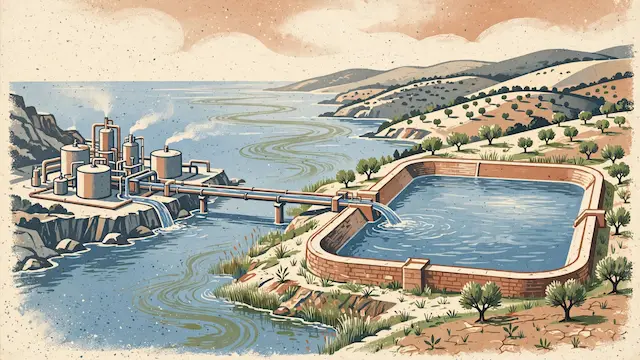
Four days into a severe water crisis, most of Israel's Mediterranean desalination plants remain offline or operating at reduced capacity, contradicting Energy Minister Eli Cohen's assurances of a swift resolution. As of Thursday afternoon, only the Hadera desalination facility is functioning normally, having operated continuously since the crisis began on Saturday. The Palmahim and Sorek 2 plants are currently running at half their normal output, while Sorek 1, Ashdod, and Ashkelon plants are completely shut down. Officials estimate the unusual bloom of micro-algae, originating from the Nile Delta in Egypt, has created a 100-kilometer-long and 7-kilometer-wide plume of turbid seawater affecting the desalination facilities.
The partial operation of Palmahim and Sorek 2 is a risk management measure to prevent damage to their filtration systems from the highly turbid water. These plants, designed to produce 18,000 cubic meters of desalinated water per hour, are currently supplying only half that amount. In response to the ongoing shortage, national water company Mekorot has quadrupled its pumping rate from the Sea of Galilee, drawing over a million cubic meters daily, despite the lake's level being below the red line. Mekorot is also utilizing approximately 1,000 wells and boreholes nationwide, reactivating dozens of older ones with Health Ministry approval for emergency use. During the night, when water consumption is lower, Mekorot is channeling large volumes into its reservoirs to bolster supply capabilities for all consumers, including agriculture in remote areas.
Mentioned
The same event, reported separately by each outlet. Open a few to compare what different newsrooms emphasize — and what they leave out.
Left 2Centre 8Right 4Haredi 2Other 7