
Water Supply to Southern Agriculture Restored After Desalination Plant Outages
Translated & summarized from Davar by baba
Israel has restored water supply to southern agriculture after several major desalination plants were shut down due to algal blooms. While most plants are back online, three remain offline, and conservation efforts are still advised.
The story in 5 lines · by baba
- Southern Israeli agriculture water supply restored overnight.
- Three major desalination plants remain offline.
- Algal bloom from Nile Delta likely caused the disruption.
- Household water supply was unaffected.
- Authorities urge continued water conservation.
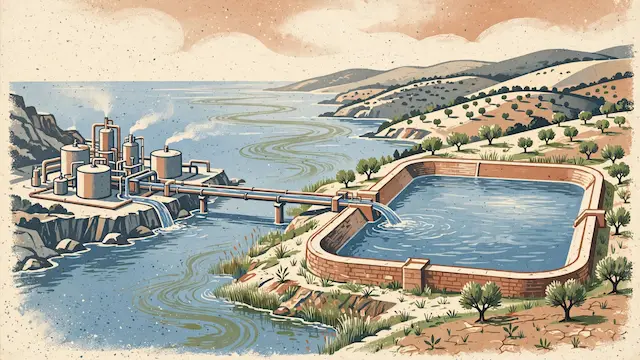
Water supply to agriculture in southern Israel was restored overnight between Tuesday and Wednesday, following disruptions caused by the shutdown of desalination plants along the Mediterranean coast. As of Wednesday morning, the plants in Ashkelon, Ashdod, and Sorek A remained offline. Sorek B and Palmahim were operating at half capacity, while the Hadera plant continued normal operations. The Ministry of Energy and Infrastructure and the Water Authority announced that the resumption of agricultural water supply was made possible by the partial return of desalination plants to operation, combined with increased pumping from wells and the Sea of Galilee, and the replenishment of reservoirs. Water supply to households continued uninterrupted.
Despite the improvement, authorities requested continued conservation of water for public gardening. The Water Authority's operations center, along with Mekorot (the national water company) and the Ministry of Energy, is monitoring the water economy and adjusting supply based on desalination plant activity. The Ministry of Agriculture had warned of potential damage to produce ahead of the upcoming Jewish holidays due to the water shortage. Minister Oren Lavi had identified areas of scarcity, particularly in the south and the Negev region, with difficulties reported in the Nitzana gateway, Ramat Negev, Hof Ashkelon, and Sdot Negev regional councils, as well as in the Shfela, Har, Gizer, Binyamin, and East Lachish areas.
At the peak of the incident, five of the six major desalination plants along the Mediterranean coast were affected: Ashkelon, Ashdod, Palmahim, Sorek A, and Sorek B. While some have since resumed operations, their output fluctuates with sea conditions. An initial assessment by the Israel Oceanographic and Limnological Research Institute suggests that a bloom of microscopic algae from the Nile Delta, carried by sea currents, caused the turbidity affecting the plants. Investigations are ongoing.
Minister of Energy and Infrastructure Eli Cohen stated, "Despite the unusual natural phenomenon, the water economy is proving its resilience. Thanks to intensive work, we have renewed the water supply for agriculture, and household water supply continues as usual. I thank the employees of the Water Authority, Mekorot, and the Ministry of Energy for their dedicated work for the citizens of Israel."
Mentioned
The same event, reported separately by each outlet. Open a few to compare what different newsrooms emphasize — and what they leave out.
Left 2Centre 8Right 4Haredi 2Other 7