Israel's Privatized Desalination Plants Refuse to Operate During Crisis
Translated & summarized from Walla by baba
Most of Israel's privately owned desalination plants have been shut down for days due to algae-induced seawater turbidity, impacting agriculture and public gardens. Private operators demanded significant compensation to resume operations, highlighting issues with the country's privatization policy.
The story in 5 lines · by baba
- Desalination plants shut down due to algae, impacting water supply.
- Private operators demanded high compensation to resume operations.
- Drinking water supply remains stable from alternative sources.
- Agriculture and public gardens are significantly affected.
- Israel privatized its major desalination facilities.
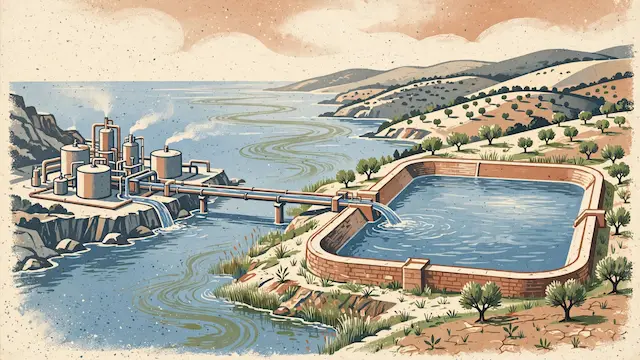
Most of Israel's desalination plants have been shut down for four and a half days due to high turbidity in seawater caused by algae drifting from Egypt. While the Hadera plant and parts of Sorek B and Palmahim plants are operational, the ongoing issue means there is no clear end in sight. The primary impact is on agriculture, with farmers unable to irrigate crops, and local authorities halting public garden watering. Drinking water supply remains largely stable, with increased pumping from northern drilling sites by Mekorot, the national water company.
The crisis highlights the consequences of Israel's privatization of its desalination facilities. According to an insider, most private operators, except for one, refused to operate the plants during the turbidity event without significant financial compensation. "All the desalination plant operators disappeared the moment the problem arose," the source told Walla. "Only one operator showed patriotism and was willing to join the effort. After the Water Authority promised compensation of over 50% on every liter of water, and announced it would pay 4 NIS per liter instead of 2.5, they reappeared. This is what happens when the state privatizes itself. In an emergency, it had to beg private companies to help the public. This is not how it was supposed to be."
Israel operates six major coastal desalination plants, all privately owned. The last state-owned facility, Ashdod, was sold in 2022. Other plants are owned by consortia including Shapir Group, BlueGen, Keystone Fund, Veridis, Migdal, and IDE Technologies. Sorek A is owned by Dan, and Sorek B, the newest and largest, is operated by IDE Technologies. A smaller plant in the Western Galilee is also managed by IDE. Smaller facilities in Eilat and the Arava, operated by Mekorot, were retained by the state due to lack of private investor interest.
Despite the operational challenges, the source assured that there is no immediate concern for drinking water shortages, as pumping continues around the clock. There is hope that shifting winds might push the algae back south by the weekend.
Mentioned
The same event, reported separately by each outlet. Open a few to compare what different newsrooms emphasize — and what they leave out.
Left 2Centre 8Right 4Haredi 2Other 7