Israel Partially Restarts Desalination Plants Amid Water Quality Concerns
Translated & summarized from Channel 13 by baba
Israel has partially restarted two desalination plants despite pollution concerns to avert a domestic water shortage. The decision involves a 'calculated risk' of damaging plant equipment, with the government pledging compensation to operators.
The story in 5 lines · by baba
- Two Israeli desalination plants partially restarted due to potential water shortage.
- Decision made despite exceeding pollution limits and risk to equipment.
- Government to compensate private operators for potential damage.
- Public gardening and agriculture water use to be reduced.
- Water Authority considering operating plants below standard.
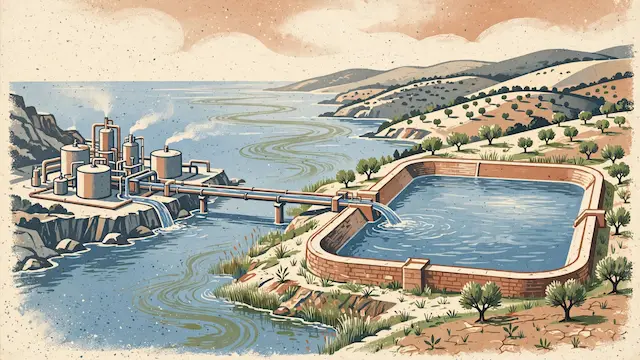
Israel's Energy Minister Eli Cohen ordered the partial reactivation of two desalination plants, Sorek B and Palmachim, on Tuesday to prevent a domestic water shortage. This decision comes despite exceeding permissible pollution levels, with concerns that the plant membranes could be damaged. The state has committed to compensating private operators for any such damage.
New aerial footage indicates that the pollution was present in Israeli waters about a week ago and did not dissipate over the weekend. In response to the potential shortage, the Water Authority is considering operating one of the desalination plants below standard, a move described by an official as a 'calculated risk.'
Earlier on Tuesday, five out of six private desalination plants were temporarily shut down due to increased turbidity in seawater after operating overnight. Consequently, the Water Authority and the Ministry of Energy and Infrastructure instructed local authorities to reduce public gardening and agricultural water usage, as well as other public consumption.
The Water Authority assured that household water supply would continue, with localized operational centers addressing specific problem areas. However, they did not confirm whether a shortage in tap water was expected. The Ministry of Energy stated that the supply of fresh water for agriculture and public gardening has not yet resumed and aims to bring additional plants online by Tuesday night, depending on water quality improvements.
On Monday, the Water Authority reported that severe seawater turbidity, caused by the past weekend's weather, led to the temporary shutdown of some private desalination plants and a reduction in fresh water supply to agriculture in the south. They added that the water economy is fully managed, with Mekorot increasing production from available sources, and estimated that some desalination plants would resume operations soon.
Mentioned
The same event, reported separately by each outlet. Open a few to compare what different newsrooms emphasize — and what they leave out.
Left 2Centre 8Right 4Haredi 2Other 7