
Israel Faces Continued High Temperatures and Heat Stress
Translated & summarized from Davar by baba
Israel is experiencing unusually high temperatures and heat stress, with above-average readings expected to continue through Wednesday. A cooling trend and potential rain are forecast for the end of the week.
The story in 5 lines · by baba
- Unusually high temperatures persist across Israel.
- Heat stress is expected in several valleys and other areas.
- Temperatures will remain above average through Wednesday.
- A cooling trend and possible rain are forecast for the weekend.
- Localized light rain may occur on Thursday.
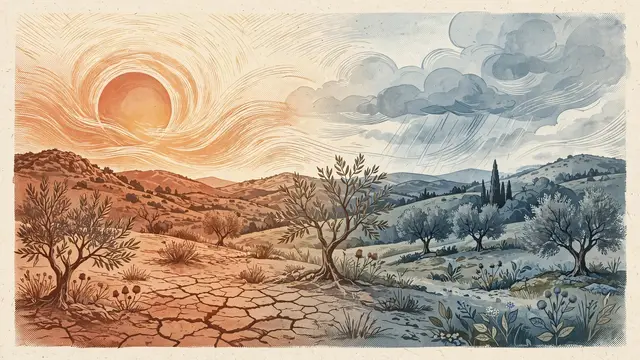
Israel is experiencing unusually high temperatures for this time of year, with heat stress expected across the country on Tuesday. While morning clouds will dissipate, temperatures will remain significantly above average, particularly in mountainous and inland areas. Heavy heat stress is forecast for the Beit She'an Valley, Kinneret Basin, and Jordan Valley from noon until 7 p.m., with moderate heat stress anticipated in other regions.
Overnight, skies will be partly cloudy to clear. Expected temperatures include Tel Aviv 23-32°C (73-90°F), Jerusalem 21-32°C (70-90°F), Haifa 23-32°C (73-90°F), Be'er Sheva 19-35°C (66-95°F), Safed 22-33°C (72-91°F), Tiberias 23-37°C (73-99°F), and Eilat 26-41°C (79-106°F).
Wednesday is expected to be mostly clear with no significant temperature changes, continuing the trend of above-average heat, especially inland and in the hills. A cooling trend is anticipated towards the end of the week, with the possibility of rain. On Thursday, skies will clear after morning clouds, and temperatures will drop slightly, particularly in the mountains and inland areas, though they will still be higher than usual for the season. Partial cloudiness is expected, with a chance of light, localized rain, mainly in northern Israel and along the coastal plain, through the afternoon.
Mentioned
The same event, reported separately by each outlet. Open a few to compare what different newsrooms emphasize — and what they leave out.
Left 1Centre 4Right 4Haredi 2Arab 2Other 5

















