
Israel Faces Century-Low Water Reserves Amid Climate Shifts and Drought
Translated & summarized from Davar by baba
Israel's available water reserves have hit a 100-year low of 208 million cubic meters over two years, despite recent rainfall nearing average levels. Climate change is altering precipitation patterns, with less rain in the north and intense floods in the south, impacting water replenishment. The Sea of Galilee is critically low, while flash floods are common in the south. The Water Authority cites drought and insufficient desalination capacity growth as key issues, stressing the need for better water management.
The story in 6 lines · by baba
- Israel's available water reserves have reached a 100-year low of 208 million cubic meters over the past two years.
- Recent rainfall reached 95% of the multi-year average, but failed to replenish water lost during drought.
- Climate change is causing less rain in northern Israel and more intense flash floods in the south.
- The Sea of Galilee is critically low, just 49 centimeters above its lower red line.
- Israel faces a water deficit due to drought and insufficient growth in desalination capacity.
- The Water Authority director stressed the need for better water resource management and planning.
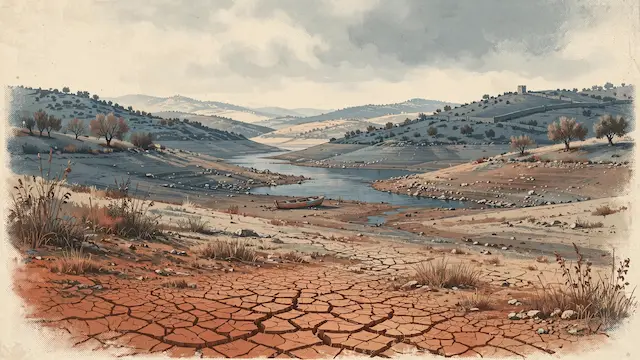
Israel's available water reserves have reached a century-low, totaling just 208 million cubic meters over the past two years, according to a report by the Hydrological Service released by the Water Authority. Despite rainfall in the most recent season reaching approximately 95% of the multi-year average, a significant recovery from the previous year's drought, the water reserves have not replenished the losses incurred during the drought.
The report attributes the severe water shortage to a combination of rainfall patterns and the overall water economy. Global warming is cited as a factor in climate change affecting Israel, leading to decreased rainfall in the north, while central regions saw similar amounts and the south experienced unprecedented heavy rainfall. This shift impacts the replenishment of northern water bodies, including the Sea of Galilee, rivers, and underground reservoirs.
The Sea of Galilee's water level began 2026 at 213.08 meters below sea level, reaching its lowest point for the season at 213.45 meters in mid-December before rising to 212.51 meters, which is 3.71 meters below the upper red line and only 49 centimeters above the lower red line.
Conversely, the southern Z'alim stream experienced record-breaking flash floods with a peak flow of 570 cubic meters per second due to intense, short bursts of rain. While these floods temporarily slowed the decline of the Dead Sea, with its level dropping only 18 centimeters in early 2026 compared to 63 centimeters in the same period the previous year, the rapid rainfall also hinders groundwater absorption.
Israel's water management system, considered highly efficient, is facing a significant deficit exacerbated by drought and over-reliance on desalination. The growth in desalination and wastewater treatment capacity is not keeping pace with the rapidly increasing population and declining rainfall. A major algae bloom in September 2026 temporarily shut down five desalination plants, forcing increased reliance on existing reserves. Yitzhak Lipshitz, Director of the Water Authority, emphasized the gap between national rainfall data and actual water source levels, highlighting the need for continuous monitoring, forecasting, long-term planning, and flexible water resource management.
The same event, reported separately by each outlet. Open a few to compare what different newsrooms emphasize — and what they leave out.
Left 1Centre 5Right 2Haredi 1Arab 1Other 7

















Not the same event — other stories that share this one’s people, places, or theme: background, reactions, and follow-ups.
