
Israel Faces Water Crisis Amid Record Low Lake Levels and Drought
Translated & summarized from Cursorinfo by baba
Israel is experiencing a severe water crisis, with the Sea of Galilee recording its lowest inflow in 100 years due to two consecutive dry seasons and reduced rainfall in key northern areas. Desalination plant disruptions further strained natural resources, forcing increased extraction from the Sea of Galilee. Despite near-normal national rainfall, northern regions and rivers are suffering, while southern areas face destructive floods. Experts warn of prolonged regional drought exacerbated by human activity.
The story in 6 lines · by baba
- The Sea of Galilee has recorded its lowest water inflow in 100 years over the past two seasons.
- Rainfall in the Sea of Galilee basin was 90% of normal, and Western Galilee received only 85% in the 2025/26 season.
- Desalination plants were offline for six weeks due to algae, increasing reliance on natural water sources.
- Northern rivers and springs are experiencing significantly reduced water flow rates.
- Southern Israel faced destructive flash floods on April 27, 2026.
- The Eastern Mediterranean is in a prolonged drying phase, with human activity increasing drought likelihood.
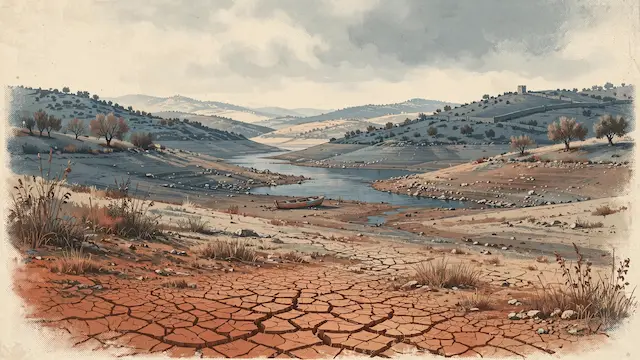
Israel is facing a severe water crisis, with natural reservoirs experiencing unprecedented strain, according to a report from the Water Resources Administration for the 2025/26 rainy season. Despite near-normal rainfall nationwide, the Sea of Galilee (Kinneret) basin received only 90% of its average, and Western Galilee received just 85%. This follows a particularly dry previous season in 2024/25, where non-desert areas received only 55% of normal rainfall, hindering soil and groundwater recovery.
The report highlights a century-long low for water inflow into the Sea of Galilee, with only 208 million cubic meters collected over the past two seasons combined. While the lake's water level rose 94 cm over the winter and spring, it remained 3.71 meters below its upper "red line" for full capacity and only 49 cm above its lower "red line." Key northern rivers and springs, including the Jordan, Taninim, Banias, and Dan, are also operating at significantly reduced flow rates, around 80-94% of their seasonal norms.
Compounding the issue, a bloom of marine algae disrupted the operation of desalination plants along the Mediterranean coast for approximately six weeks. This forced the national water company Mekorot to increase water extraction from the Sea of Galilee and the Coastal Aquifer to compensate, further straining natural resources.
Meanwhile, southern and eastern Israel experienced severe flash floods, particularly on April 27, 2026, with over 50 mm of rain falling in 1.5 hours in the Judean Desert and northeastern Negev. These floods, however, did not alleviate the overall water shortage, and the Dead Sea's level dropped by 18 cm since the start of the season.
Yechiel Lifshitz, head of the Water Resources Administration, stated that average rainfall figures no longer reflect the true state of the water sector. He emphasized the need for continuous monitoring, predictive modeling, and flexible resource management due to the heavy burden on water sources, preceding drought conditions, and anomalous flooding. Globally, the Eastern Mediterranean is experiencing a prolonged drying phase, with human activity increasing the likelihood of droughts in the region by over tenfold, according to World Weather Attribution.
Mentioned
The same event, reported separately by each outlet. Open a few to compare what different newsrooms emphasize — and what they leave out.
Centre 5Right 2Haredi 1Arab 1Other 6















Not the same event — other stories that share this one’s people, places, or theme: background, reactions, and follow-ups.

