
Kinneret Hits 100-Year Low After Two Dry Years, Water Authority Warns
Translated & summarized from Behadrei Haredim by baba
Israel's Sea of Galilee has reached its lowest level in 100 years due to two consecutive dry years, despite national rainfall being near average. The lake has accumulated only 208 million cubic meters of water over the past two years. While southern Israel experienced extreme floods, the Kinneret basin suffered significant rainfall deficits. The Water Authority warns that continued flexible management and long-term planning are crucial for water source recovery.
The story in 5 lines · by baba
- The Sea of Galilee has reached its lowest level in 100 years after two dry seasons.
- Only 208 million cubic meters of water accumulated in the Kinneret over the past two years.
- National rainfall was near the long-term average, but the Kinneret basin received only 90% of its average.
- Southern Israel experienced extreme flash floods, while northern water flows were significantly impacted.
- Water Authority Director Yechiel Lipschitz stressed the need for continued flexible management and planning.
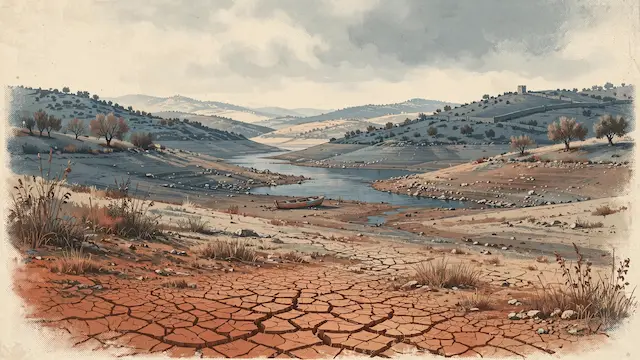
Israel's Water Authority has issued a stark warning regarding the Sea of Galilee (Kinneret), revealing that it has reached its lowest point in a century. The hydrological service's report for the 2025/26 rainy season indicates that despite national rainfall reaching approximately 95% of the long-term average, the Kinneret basin experienced a severe deficit. Over the past two years, only 208 million cubic meters of water have accumulated in the lake, the lowest figure since measurements began 100 years ago. While the Kinneret's level rose 94 centimeters from its mid-December low, it stood at 212.51 meters below sea level in early May, still 3.71 meters below the upper red line. This situation is exacerbated by geographical disparities in rainfall, with the coastal and Yarkon-Taninim basins receiving near-average rainfall, while the north, particularly the Kinneret basin and western Galilee, received only 90% and 85% of their average, respectively. Consequently, water flow in northern rivers and springs was significantly impacted. In contrast, southern Israel experienced an unusually wet season with extreme flooding. Heavy rainfall on April 27th caused flash floods in the northeastern Negev and Judean Desert, with one area receiving 50 mm of rain in just 90 minutes, a rare event. Nahal Tze'elim recorded its highest-ever flow rate, and the Dead Sea's level dropped only 18 cm this season, a significant decrease compared to the usual rate. Water Authority Director Yechiel Lipschitz cautioned that near-average rainfall does not guarantee recovery, emphasizing that water sources are still recovering from previous drought years and require flexible management, continuous monitoring, and long-term planning.
Mentioned
The same event, reported separately by each outlet. Open a few to compare what different newsrooms emphasize — and what they leave out.
Centre 3Right 2Haredi 1Other 1







Not the same event — other stories that share this one’s people, places, or theme: background, reactions, and follow-ups.

