
Kinneret Water Levels Hit 100-Year Low Amid Drought
Translated & summarized from Kan News by baba
Israel's Kinneret has reached its lowest water levels in 100 years, with only 208 million cubic meters available after two dry seasons. While some regions like the Jordan River and western Galilee saw below-average flow, southern and eastern Israel experienced severe flash floods. The Dead Sea also continued its decline. Water Authority Director Yechiel Lipschitz stressed the importance of ongoing monitoring and flexible management of water resources.
The story in 6 lines · by baba
- The Kinneret's available water has hit a 100-year low, totaling just 208 million cubic meters.
- The Kinneret's water level fluctuated between 213.45 meters and 212.51 meters below sea level.
- Jordan River flow was 80% of average, while the Dan spring was at 94% in late April.
- Southern and eastern Israel experienced unusually heavy rainfall and flash floods.
- The Dead Sea level dropped 18 centimeters by the end of April.
- Water Authority Director Yechiel Lipschitz highlighted the need for flexible water management.
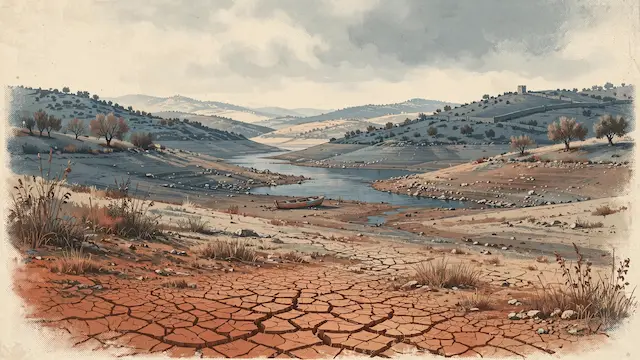
Israel's Water Authority reported on Tuesday that the amount of available water in the Kinneret (Sea of Galilee) has reached its lowest point in 100 years of measurements. The past two rainy seasons combined yielded approximately 208 million cubic meters, the lowest figure recorded. The Kinneret's water level began the hydrological year at 213.08 meters below sea level. It dropped to a seasonal low of 213.45 meters below sea level in mid-December before rising 94 centimeters to a seasonal peak of 212.51 meters below sea level by early May.
Flow rates in the Jordan River at the Jisr al-Ghazali station were recorded at 11.4 cubic meters per second in late April, about 80% of the long-term average for that time. The Dan spring had a flow rate of 7.6 cubic meters per second, approximately 94% of its average. The coastal and Yarkon basins received about 100% of their annual average, while the western Galilee received around 85%.
In contrast, southern and eastern Israel experienced unusually heavy rainfall events and flash floods. On April 27, 2026, the Judean Desert and northeastern Negev saw over 50 millimeters of rain in a concentrated area, much of it within about 90 minutes. Peak flow in Nahal Tzeelim reached 570 cubic meters per second, causing the water level in the stream to rise by approximately four meters in about half an hour.
Meanwhile, the Dead Sea level dropped by 18 centimeters from the start of the season until the end of April, a significant decrease compared to the 63 centimeters recorded in the same period last year. Water Authority Director Yechiel Lipschitz emphasized the need for continuous monitoring and flexible water resource management, noting that "even when the amount of rain approaches the average, water sources continue to bear the impact of the previous drought year."
Mentioned
The same event, reported separately by each outlet. Open a few to compare what different newsrooms emphasize — and what they leave out.
Centre 4Right 2Haredi 1Other 1








Not the same event — other stories that share this one’s people, places, or theme: background, reactions, and follow-ups.

