
Kinneret Hits Century-Low Water Levels After Two Years of Drought
Translated & summarized from Hamal by baba
Two consecutive years of drought have caused the Sea of Galilee to reach its lowest water level in 100 years, with the last rainy season failing to compensate for the deficit. Despite rainfall reaching 95% of the average nationally, regional variations were significant, and the Kinneret's level remains critically low. Conversely, southern Israel experienced extreme flash floods, with the Tsalim stream recording its highest-ever flow. The Water Authority stressed the need for continuous monitoring and flexible management of water resources.
The story in 6 lines · by baba
- The Sea of Galilee has reached its lowest water level in 100 years due to two consecutive years of drought.
- The 2025-2026 rainfall season saw precipitation at 95% of the average, but failed to offset the previous year's deficit.
- The Kinneret's water level is 3.71 meters below the upper red line and only 49 centimeters above the lower red line.
- Southern Israel experienced extreme rain events and flash floods, with the Tsalim stream recording a record flow.
- The Dead Sea's water level drop slowed significantly, decreasing by 18 cm compared to 63 cm last year.
- Water Authority Director Yechiel Lipschitz highlighted the importance of flexible water resource management.
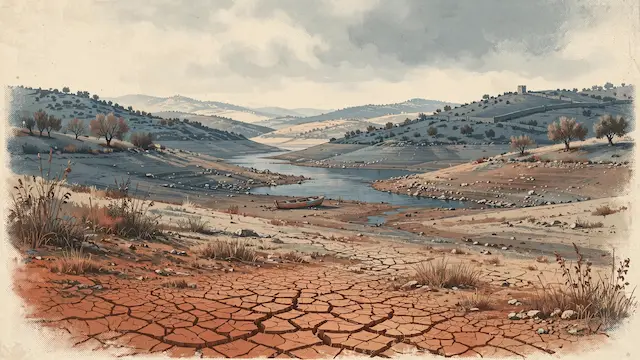
Two consecutive years of low rainfall have led to a historic low in the Sea of Galilee's water volume, according to a report by the Water Authority's Hydrological Service. The 2025-2026 rainfall season's precipitation was insufficient to compensate for the deficit from the previous drought year, resulting in the lowest available water volume in the Kinneret in 100 years of measurements. From the start of the season until the end of April, the accumulated available water volume was approximately 142 million cubic meters. Combined with the drought season, the total available water over the two seasons was only about 208 million cubic meters. Although the last season saw rainfall at 95% of the average, there were significant regional disparities. The Kinneret basin received about 90% of the average, while the Western Galilee received only about 85%. In contrast, the Coastal Plain received about 100% of the average.
The Kinneret's water level began the year at 213.08 meters below sea level. It reached its seasonal low of 213.45 meters below sea level in mid-December and rose 94 centimeters to a seasonal peak of 212.51 meters below sea level in early May. Despite this rise, the level remains 3.71 meters below the upper red line and only 49 centimeters above the lower red line. Flow rates in northern streams and springs also reflect the water shortage. By the end of April, the Jordan River's flow was 11.4 cubic meters per second, about 80% of the long-term average for this period. The Dan spring had a flow of 7.6 cubic meters per second, about 94% of average, and the Banias spring measured about 90% of average.
In contrast to the north, southern and eastern Israel experienced an unusually high number of intense rain events and flash floods. On April 27, 2026, an extreme rain event occurred in the Judean Desert and northeastern Negev, with over 50 millimeters of rain falling in the event's epicenter in about 90 minutes. The Meteorological Service estimates the intensity of this rainfall to be rare, with a return period of 100 years or more. This led to significant flows in many regional streams, with the Tsalim stream recording a peak flow of 570 cubic meters per second, the highest since measurements began. The water level in the stream rose about four meters in approximately 30 minutes. This event is also considered rare, with a return period for its peak flow estimated at over 50 years.
The Dead Sea also saw a slowdown in its water level drop. From the start of the season until the end of April, the level dropped 18 centimeters, compared to a 63-centimeter drop in the same period last year. Water Authority Director Yechiel Lipschitz commented on the findings, stating that the past rainy season highlights the gap between national rainfall data and the actual state of water sources. He emphasized that even when rainfall approaches average, water sources continue to bear the impact of the previous drought year. Lipschitz also noted the exceptional season of flood events and their intensity in the south, underscoring the importance of continuous monitoring, forecasting, long-term planning, and flexible management of Israel's water resources.
Mentioned
The same event, reported separately by each outlet. Open a few to compare what different newsrooms emphasize — and what they leave out.
Centre 4Right 2Haredi 1Other 4











Not the same event — other stories that share this one’s people, places, or theme: background, reactions, and follow-ups.

