
Israel Faces Lowest Kinneret Water Levels in Over a Century
Translated & summarized from N12 by baba
Israel's Sea of Galilee has reached its lowest water levels in over 100 years due to a two-year drought in the north. Despite near-average national rainfall this past season, the Kinneret basin received significantly less, exacerbating the deficit. Meanwhile, southern Israel experienced extreme flash floods with record-breaking water flows. Water Authority Director Yechiel Lipschitz cautioned that water sources are still affected by the previous drought and stressed the importance of ongoing water management.
The story in 5 lines · by baba
- The Sea of Galilee has reached its lowest water volume in 100 years of measurements.
- Two consecutive years of drought in northern Israel have severely impacted the Kinneret's water levels.
- National rainfall was near average, but regional disparities show deficits in the north.
- Southern Israel experienced exceptional flash floods and record water flows in wadis.
- Water Authority Director warned that water sources are still recovering from the previous drought year.
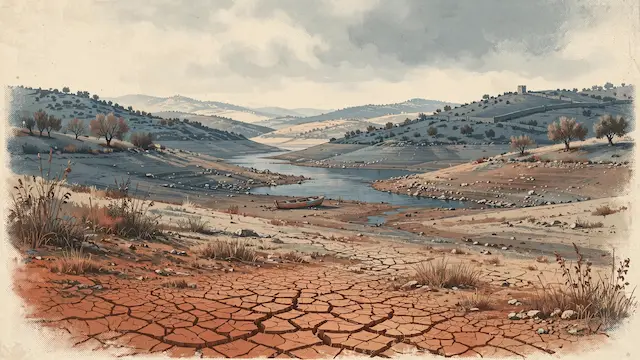
Israel's Water Authority has reported that the available water volume in the Sea of Galilee (Kinneret) has reached its lowest point in 100 years of measurements, following two years of drought in the north. This data emerges after a crisis in September that saw nearly all desalination plants shut down due to turbid water from Egypt, raising concerns about water supply disruptions.
While national rainfall reached approximately 95% of the multi-year average for the 2025/26 season, significant regional disparities exist. The Kinneret basin received about 90% of its average rainfall, and the western Galilee only 85%. In contrast, the coastal and Yarkon-Tanninim basins received around 100% of their average.
The most concerning figures are for the Kinneret basin, where the accumulated water volume from the start of the rainy season until the end of April was about 142 million cubic meters. Combined with the previous drought season, the total available water over two seasons is approximately 208 million cubic meters, the lowest recorded in a century. The Water Authority stressed that despite this year's improved rainfall, the severe deficit from the previous year continues to impact natural water sources.
The Kinneret's water level reflects this scarcity. It began the hydrological year at 213.08 meters below sea level, dropped to a seasonal low of 213.45 meters in mid-December, and reached a seasonal peak of 212.51 meters below sea level in early May. This peak is still 3.71 meters below the upper red line.
Conversely, the southern regions experienced unusually heavy rainfall and flash floods. On April 27th, areas in the Judean Desert and northeastern Negev received over 50 millimeters of rain in about 1.5 hours, with rainfall intensities estimated to have a return period of 100 years or more. A record flow of 570 cubic meters per second was measured in Nahal Tsalim, the highest since measurements began, with a flow intensity estimated to have a return period of over 50 years.
Water Authority Director Yechiel Lipschitz warned that rainfall near the average does not necessarily indicate a recovery of water sources, as they continue to bear the impact of the previous drought year. He emphasized the need for continuous monitoring, forecasting, long-term planning, and flexible management of Israel's water resources.
Mentioned
The same event, reported separately by each outlet. Open a few to compare what different newsrooms emphasize — and what they leave out.
Centre 3Right 2Haredi 1Other 1







Not the same event — other stories that share this one’s people, places, or theme: background, reactions, and follow-ups.

