
Sea of Galilee Hits 100-Year Low Amid Severe Drought
Translated & summarized from Ice by baba
Israel's Sea of Galilee has reached its lowest water levels in 100 years due to a severe two-year drought in the north. Despite national rainfall reaching 95% of average, the lake's basin received only 90%, leading to a combined total of 208 million cubic meters of available water over two seasons, the lowest in a century. Reduced river and spring flows are also reported. The lake is currently only 49 centimeters above its lower red line, highlighting the critical water shortage.
The story in 5 lines · by baba
- The Sea of Galilee has reached its lowest water levels in 100 years due to a severe two-year drought.
- A total of 208 million cubic meters of available water over two seasons is the lowest figure in a century of measurements.
- Nationally, rainfall was 95% of average, but the Sea of Galilee basin received only 90%.
- Reduced river and spring flows are evident across northern Israel.
- The lake is currently only 49 centimeters above its lower red line, indicating a critical shortage.
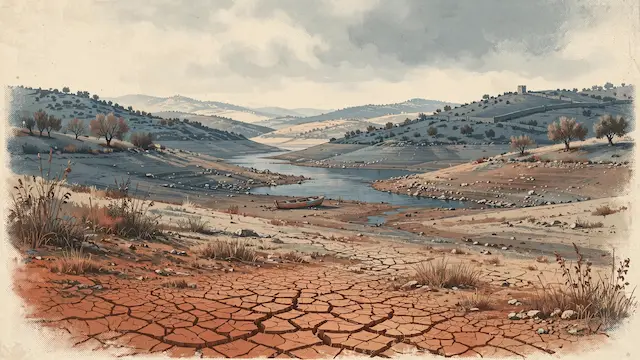
The Sea of Galilee, once Israel's primary national freshwater source, is experiencing its lowest water levels in 100 years due to a severe drought impacting the north. Historically, the lake was crucial for supplying drinking and irrigation water nationwide, particularly after the "National Water Carrier" project began in 1964. However, rapid population growth and prolonged droughts, especially in the late 1990s and early 2000s, led to historically low levels, threatening the lake's ecological stability.
A significant shift occurred in the 2010s with the widespread adoption of desalination, drastically reducing Israel's reliance on the Sea of Galilee for drinking water. A "reverse carrier" project was even established to pump desalinated water into the lake to maintain its levels during dry periods. Despite these advancements, a new, alarming report from the Water Authority highlights the dramatic impact of the current drought.
Two consecutive years of insufficient rainfall in the Sea of Galilee's basin have resulted in the lowest recorded volume of available water entering the lake over a century. The 2025-2026 rainfall season failed to compensate for the deficit from the previous year. According to the Hydrological Service, accumulated available water from the start of the current season until the end of April was approximately 142 million cubic meters (mcm). Combined with the preceding dry season, the total available water over these two seasons reached only about 208 mcm, the lowest figure in 100 years of measurements.
Nationally, rainfall reached 95% of the average, but the report indicates severe regional disparities. The Sea of Galilee basin received only about 90% of its average, and the Western Galilee received 85%, while the coastal plain met 100% of its average. Conversely, southern regions experienced unusually high rainfall, which did not affect the Sea of Galilee.
The drought's impact is also evident in reduced river and spring flows in the north. By the end of April, the Jordan River's flow was 11.4 cubic meters per second, only 80% of the multi-year average for this period. The Dan spring had a flow of 7.6 cubic meters per second (94% of average), and the Banias spring measured 90% of its multi-year average. The lake began the year at 213.08 meters below sea level, reached a seasonal low of 213.45 meters in mid-December, and rose to a seasonal peak of 212.51 meters below sea level by early May. Despite this rise, the lake remains 3.71 meters below its full level (the upper red line) and only 49 centimeters above its lower red line.
Mentioned
The same event, reported separately by each outlet. Open a few to compare what different newsrooms emphasize — and what they leave out.
Centre 4Right 2Haredi 1Other 5












Not the same event — other stories that share this one’s people, places, or theme: background, reactions, and follow-ups.

