
Israel's Kinneret Water Level Hits 100-Year Low Amid Drought Aftermath
Translated & summarized from Vesty by baba
Israel's Kinneret water level has reached its lowest point in 100 years, according to the Water Resources Administration's October 13 warning. Despite a better rainy season, the aftermath of the 2024-2025 drought persists, with the Kinneret basin receiving only 90% of average rainfall. The total water added over the last two winters was 208 million cubic meters, a century low. While southern Israel experienced record floods, the Kinneret remained perilously close to its "red line" throughout the season.
The story in 6 lines · by baba
- Israel's Kinneret water level has hit a 100-year low due to lingering drought effects.
- The Kinneret basin received only 90% of its average rainfall in the 2025-2026 season.
- Total water added to the Kinneret over the past two winters was 208 million cubic meters.
- The Kinneret's peak level remained 3.71 meters below the upper "red line."
- Southern Israel experienced record floods, contrasting with the Kinneret's low levels.
- River and spring flows across northern Israel are significantly below average.
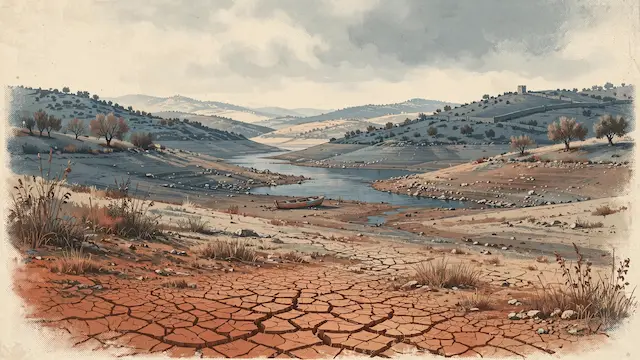
Israel's Water Resources Administration issued a warning on Tuesday, October 13, regarding the continued decline in the Kinneret's (Sea of Galilee) water level. Despite a better rainy season than the previous one, the effects of the extreme drought from 2024-2025 persist, particularly impacting northern water sources and the lake's basin. According to the hydrological service's report for the 2025-2026 season, rainfall across Israel reached approximately 95% of the annual average between October and April. However, the Kinneret basin received only 90% of its average, and Western Galilee received 85%.
The warning comes amid the lingering effects of a desalination crisis in September 2026. The amount of available water in the Kinneret by the end of April was about 142 million cubic meters. Combined with the dry 2024-2025 season, the total for these two winters reached roughly 208 million cubic meters, marking the lowest figure for this period in 100 years of measurements.
Yekhezkel Lifshitz, head of the Water Resources Administration, stated that near-average rainfall nationwide does not automatically signify a recovery of water sources, which are still suffering from the previous drought. Conversely, southern Israel experienced an unusual number of strong floods during the season. Lifshitz emphasized the need for continuous monitoring, forecasting, and long-term adaptive water management strategies.
During the winter, the Kinneret's level rose but remained close to the lower "red line." At the start of the hydrological year, the lake was at 213.08 meters below sea level, dropping to a seasonal low of 213.45 meters by mid-December. It then rose 94 centimeters, reaching a seasonal peak of 212.51 meters below sea level in early May. Even at its highest point, the level was 3.71 meters below the upper red line and only 49 centimeters above the lower one.
The water deficit is also evident in river and spring flow rates. By late April, the Jordan River's flow at Gesher Ha'Pkak was 11.4 cubic meters per second, about 80% of the average for that time of year. The Dan spring's flow was 7.6 cubic meters per second (94% of normal), Banias was 2.7 cubic meters per second (90%), and Taninim springs were 0.64 cubic meters per second (around 80% of normal).
In contrast, southern and eastern Israel saw a record number of intense floods. On April 27, 2026, heavy rainfall in the Judean Desert and northeastern Negev exceeded 50 millimeters in the epicenter, with most falling in about 1.5 hours, causing water to surge through many wadis. The Tzeelim stream recorded a peak flow of 570 cubic meters per second, the highest in its measurement history, with water levels rising four meters in approximately 30 minutes. This event was part of a series of floods making the 2025-2026 season notable for such occurrences. The Dead Sea's level continued to drop, but at a significantly slower rate than in 2025, decreasing by 18 centimeters by the end of April compared to 63 centimeters in the same period the previous year.
Mentioned
The same event, reported separately by each outlet. Open a few to compare what different newsrooms emphasize — and what they leave out.
Left 1Centre 5Right 2Haredi 1Arab 1Other 7

















Not the same event — other stories that share this one’s people, places, or theme: background, reactions, and follow-ups.

