
Israel Faces Water Crisis as Desalination Plants Shut Down, Threatening Agriculture
Translated & summarized from Ynet by baba
Most of Israel's desalination plants have shut down due to seawater turbidity, causing severe water shortages for agriculture, particularly in the Negev. Farmers face irreversible crop damage and financial ruin, demanding government compensation and intervention to resolve the crisis.
The story in 5 lines · by baba
- Desalination plants shut down, causing severe water shortages for Israeli farmers.
- Farmers in the Negev face irreversible crop damage and potential farm closures.
- The crisis threatens tomato crops, a major agricultural product for holidays.
- Farmers are demanding immediate government intervention and compensation.
- Water Authority assures household supply but cuts agricultural and public use.
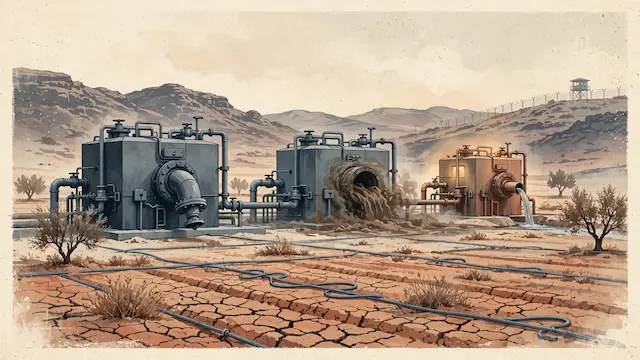
Farmers in Israel's Negev region are facing a severe water shortage, with many reporting no water for 24 hours, threatening to collapse their farms during the crucial growing season. The shutdown of most of the country's desalination plants, caused by turbidity in the seawater, has led to drastic reductions in water supply. In the Nitzana Sands area, a major tomato-growing region, farmers warn that even a single day without irrigation could cause irreversible damage to crops, potentially leading to the closure of farms that represent millions of shekels in investment.
The situation has prompted the Farmers' Association of Israel to demand immediate government intervention and the establishment of a compensation plan. As of Tuesday morning, the large desalination plant in Hadera was operational, but facilities in Ashkelon, Ashdod, Palmahim, and Sorek (both plants) were shut down. The Sorek plants briefly operated at partial capacity, offering temporary relief, but were subsequently idled again due to water quality issues. The Eilat desalination plant, however, continues to operate normally.
The Water Authority has stated that due to the plant shutdowns, which began on Saturday, local authorities will reduce public gardening and agricultural activities, as well as curb public water usage. While the authority assured that household water supply would continue, it acknowledged that operations in areas with specific problems would be scaled back, with the Water Authority's operations center providing targeted assistance. Water supply has already ceased in the moshav of Netayim and the kibbutz of Palmahim in the Shephelah region, prompting emergency discussions by local council leaders, with fears that the water outages could spread to additional communities.
Farmers like Ro'i Yosef, a 15-year tomato grower in Beer Milka, expressed frustration with the Water Authority's handling of the crisis, stating that this is the first time water has been cut off to agriculture. He highlighted that farmers in the region are the primary suppliers of tomatoes for holidays and that a 24-hour interruption could be fatal to the crops. Doron Hebel, another farmer, described the situation as "survival mode," noting that his 65-dunam farm is currently laden with fruit that needs continuous watering to ripen for winter marketing. He warned that if the crisis is not resolved quickly, it could lead to the loss of millions of shekels per farm and potentially result in farmers blocking roads.
Regional council leaders are attempting to mitigate the crisis by redirecting scarce freshwater resources, such as those used for solar energy facilities, to agriculture. Agricultural leadership has urgently appealed to the Ministers of Finance, Agriculture, and Energy for immediate intervention, emphasizing the risk to hundreds of family farms and the potential for irreversible damage to crops. They are calling for a government compensation plan for affected farmers, particularly small family operations, stressing that every day without regular water supply deepens the damage and leads to crop loss.
Mentioned
The same event, reported separately by each outlet. Open a few to compare what different newsrooms emphasize — and what they leave out.
Centre 3Right 2Haredi 2Other 2








