Israel Halts Desalination Plants Due to Severe Sea Water Turbidity
Translated & summarized from Ynet by baba
Most of Israel's desalination plants have temporarily shut down due to severe seawater turbidity caused by weather, impacting water supply to agriculture in the south. Operations are expected to resume as water clarity improves, with domestic use prioritized over agriculture.
The story in 5 lines · by baba
- Most Israeli desalination plants halted due to severe sea water turbidity.
- Water supply to agriculture in southern Israel significantly reduced.
- Domestic water use is prioritized over agricultural needs.
- Eilat, Hadera, and Mekorot facilities remain operational.
- Resumption of operations depends on improved water clarity.
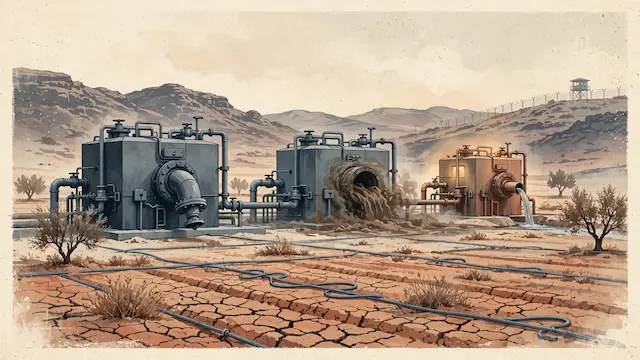
Most of Israel's private desalination plants have temporarily ceased operations due to severe turbidity in seawater, caused by recent weather conditions. The shutdown began on Saturday, with the Water Authority only reporting the issue on Monday. As a result, the authority has instructed a reduction in the supply of fresh water for agriculture in the southern region, with the Ramat Negev Regional Council completely halting water supply to agriculture.
The desalination plants in Eilat and Hadera, along with 20 local plants operated by Mekorot, continue to function. The Water Authority stated that the water economy is fully managed, with Mekorot increasing production from available sources. They estimate that some desalination facilities will resume operations soon, as professionals monitor water quality closely and are prepared for any scenario to restore full capacity once sea water clarity improves.
Turbidity exceeding a certain threshold prevents desalination plants from operating by clogging their membranes. As of Monday afternoon, only the Hadera plant was operational out of six active facilities in Israel. The Ashkelon and Ashdod plants were shut down on Saturday, while the Sorek and Palmahim plants were halted on Sunday. "There is hope that Sorek B will begin operating soon, as samples from it look good," said Water Authority Director General Hazi Lifshitz.
The total production capacity of the affected plants is approximately 750 million cubic meters annually, meaning only about 15-17% of the total annual output is currently operational. The Hadera plant produces between 120-130 million cubic meters per year. The affected plants are expected to return to operation as water turbidity decreases, with different facilities potentially resuming at different times due to variations in intake depth and location.
The problem is concentrated in the south, where water transport capacity is limited. Priority is now given to domestic use over agriculture and gardening. Efforts are underway to increase pumping from the Sea of Galilee and from drilling sites. The northern region is less affected due to its reliance on Sea of Galilee water and boreholes. Farmers using treated wastewater (effluent) are also unaffected. Only farmers in the south relying on desalinated water are currently experiencing supply disruptions. The Eshkol Regional Council has urged farmers and garden managers to immediately reduce the use of fresh water for agriculture and gardening, advising them to use effluent instead to avoid impacting domestic and drinking water supplies.
Mentioned
The same event, reported separately by each outlet. Open a few to compare what different newsrooms emphasize — and what they leave out.
Centre 3Right 2Haredi 2Other 2