Israel's Desalination Plants Shut Down Due to Seawater Turbidity
Translated & summarized from Globes by baba
Five of Israel's six major desalination plants were shut down due to high seawater turbidity, prompting concerns about water shortages. Officials have ruled out a cyberattack, attributing the issue to an environmental phenomenon. While tap water supply is expected to continue, agricultural and non-essential water use has been reduced.
The story in 5 lines · by baba
- Five of Israel's six major desalination plants shut down due to high seawater turbidity.
- The shutdown is an environmental operational issue, not a cyberattack.
- Tap water quality is not affected, but localized pressure drops may occur.
- Agricultural and non-essential water use has been reduced.
- Israel relies on desalination for 70-80% of its domestic water.
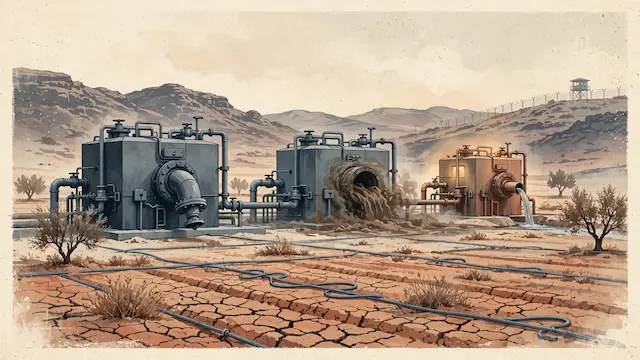
Five of Israel's six major desalination plants were temporarily shut down starting over the weekend due to unusually high turbidity in seawater, raising concerns about potential water shortages. The shutdown, which affected plants in Ashkelon, Ashdod, Palmahim, Sorek A, and Sorek B, was a precautionary measure to prevent damage to the filtration systems. The Hadera plant continued to operate, at least partially. Officials initially attributed the issue to unusual weather, but later suggested that micro-algae possibly originating from the Nile Delta might be a contributing factor, though this remains under investigation.
The high turbidity, caused by a concentration of suspended particles like sand, silt, organic matter, and algae, overwhelmed the pre-treatment and filtration systems of the reverse osmosis plants. When turbidity levels are excessively high, the systems struggle to cope, leading to clogged filters and membranes, increased system pressure, and reduced water output. Shutting down the plants prevents long-term damage that would require costly repairs and extended downtime.
While the immediate concern was a potential cyberattack, national cyber defense and water authorities have found no evidence of such an incident. The simultaneous shutdown of multiple plants is attributed to the widespread nature of the environmental phenomenon affecting the Mediterranean coast between Ashkelon and Hadera, where the intake pipes for these facilities are located.
Despite the plant shutdowns, the Water Authority and Ministry of Energy stated that the tap water supply to homes is expected to continue. There have been no official announcements regarding a threat to drinking water quality, and no instructions have been issued to boil water. However, some communities have reported localized drops in water pressure and disruptions due to the strain on local reservoirs and transmission networks.
In response to the temporary shortage, the State prioritized drinking and domestic water supplies, leading to a reduction, and in some cases a temporary halt, of water allocation to agriculture in the south. Non-essential uses like garden and park irrigation have also been curtailed. Mekorot, the national water company, is increasing production from alternative sources, including the Sea of Galilee, groundwater wells, and existing reservoirs, to compensate for the shortfall. However, the system's capacity to integrate these alternative sources has limitations, and the simultaneous failure of five major plants presents a significant challenge.
Officials have not provided a definitive timeline for when the desalination plants will fully resume operations. Each plant can only restart when seawater quality at its intake point drops below critical thresholds and remains stable enough for safe operation. The situation highlights Israel's significant reliance on desalination, which provides an estimated 70-80% of the country's domestic and urban water consumption, and underscores the vulnerability of having multiple large facilities concentrated along the same coastline.
Mentioned
The same event, reported separately by each outlet. Open a few to compare what different newsrooms emphasize — and what they leave out.
Centre 3Right 2Haredi 2Other 2