Ancient Jerusalem Aqueduct Section Discovered Near City
Translated & summarized from Davar by baba
A 300-meter section of an ancient aqueduct, dating back to the Hasmonean period (1st-2nd century BCE), has been discovered near Jerusalem. The aqueduct, which supplied water to the city for approximately 2,000 years, was found during construction for a new neighborhood. Archaeologists highlighted its impressive engineering, noting modifications made during the Ottoman period. Plans are in motion to integrate the aqueduct into the new neighborhood and create a park along its route.
The story in 6 lines · by baba
- A 300-meter section of a 2,000-year-old aqueduct was discovered near Jerusalem.
- The aqueduct supplied water to Jerusalem from the Hasmonean period until about 100 years ago.
- Excavations revealed construction phases from the Hasmonean and Ottoman periods.
- The aqueduct originally stretched 21 kilometers from the Pools of Solomon to Jerusalem.
- Plans include integrating the aqueduct into a new neighborhood and creating a park.
- The discovery will be presented at an archaeology conference in Jerusalem and Tel Aviv.
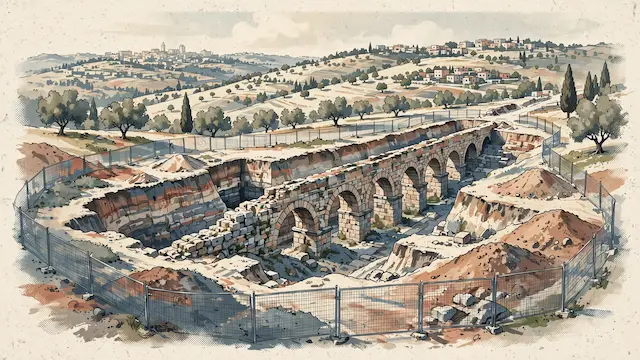
The Israel Antiquities Authority announced Sunday the discovery of a 300-meter section of an ancient aqueduct that supplied water to Jerusalem. The segment was unearthed during excavations for a new neighborhood near Kibbutz Ramat Rachel, south of the city. Antiquities Authority archaeologists estimate the aqueduct was built during the Hasmonean period, between the 2nd and 1st centuries BCE.
"The lower aqueduct to Jerusalem was an impressive engineering feat," said Dr. Benjamin Sturchen and Gail Fried, excavation directors for the Authority. They noted that the aqueduct's design was so effective it was used, intermittently, until about 100 years ago. Evidence of different construction phases in the unearthed section suggests modifications over time. Initially, water flowed through a plastered channel. Approximately 500 years ago, during the Ottoman period, a ceramic pipe was laid within the ancient channel. Later, the aqueduct wall was plastered, and stones were embedded in the plaster.
The full aqueduct, stretching about 21 kilometers from the Pools of Solomon south of Bethlehem to Jerusalem, required a very gentle gradient to ensure water flow. Access points were built along its length for maintenance and repairs. "The aqueduct is an engineering marvel," stated Dr. Amit Ram. "Even today, with all modern technologies, constructing such a project would require significant planning and effort. The thought that water was successfully brought to Jerusalem like this about 2,000 years ago is astonishing."
Plans are underway by the Jerusalem Municipality and the Israel Land Authority to integrate the aqueduct into the new neighborhood's design. The Antiquities Authority also aims to create a continuous park along the aqueduct's route from southern Jerusalem to the Old City, a project being advanced with municipal cooperation. The aqueduct will be presented this week at the 19th "Innovations in the Archaeology of Jerusalem and its Surroundings" conference, co-sponsored by the Antiquities Authority, Tel Aviv University, the Hebrew University, and the Israel Institute of Archaeology.
Mentioned
The same event, reported separately by each outlet. Open a few to compare what different newsrooms emphasize — and what they leave out.
Left 2Centre 4Right 6Haredi 1Other 2