
Ancient Jerusalem Aqueduct, 2,000 Years Old, Unearthed Near Capital
Translated & summarized from Makor Rishon by baba
An approximately 300-meter section of a 2,000-year-old Hasmonean-era aqueduct was discovered south of Jerusalem. The ancient system, which carried water from the Pools of Solomon to the Temple Mount using only gravity, served the city for centuries. The aqueduct will be preserved and incorporated into a new neighborhood's entrance. The find highlights remarkable ancient engineering and will be presented at an upcoming archaeological conference.
The story in 5 lines · by baba
- A 300-meter section of a 2,000-year-old Hasmonean aqueduct was unearthed south of Jerusalem.
- The ancient aqueduct transported water from the Pools of Solomon to the Temple Mount using gravity.
- The sophisticated engineering marvel functioned for centuries, serving Jerusalem's residents until about 100 years ago.
- The aqueduct will be preserved and integrated into the entrance of a new neighborhood.
- The find will be presented at the 19th Conference on the Innovations in the Archaeology of Jerusalem.
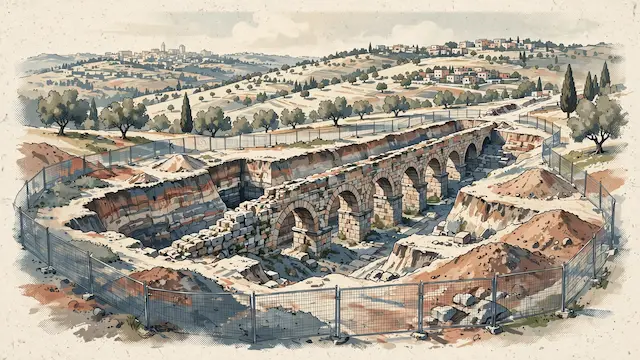
An approximately 300-meter section of an ancient aqueduct, believed to be about 2,000 years old and dating back to the Hasmonean period, has been discovered south of Kibbutz Ramat Rachel in Jerusalem. The aqueduct, which transported water from the Pools of Solomon near Bethlehem to the Temple Mount, was found during an archaeological excavation by the Israel Antiquities Authority in an area slated for a new neighborhood. This sophisticated water system, built without pumps, relied solely on gravity and a precise, gentle slope of about one meter per kilometer to move water over approximately 21 kilometers. The engineering marvel functioned for centuries, serving Jerusalem's residents intermittently until about a century ago. Excavation directors Dr. Benjamin Sturchen and Gil Fried of the Israel Antiquities Authority described it as an impressive feat, likely established by the Hasmonean kings to supply water to the city. Evidence of modifications over time was also found, including an initial tiled channel and, around 500 years ago during the Ottoman period, the insertion of a clay pipe within the ancient channel. The outer wall was also plastered and textured with stones during this later period. The discovered section will be preserved and integrated into the main entrance of the new neighborhood, allowing public viewing. Dr. Amit Ram, Director of the Jerusalem Region at the Israel Antiquities Authority, called the aqueduct an engineering wonder, noting that its construction would still be a significant undertaking today. The IAA is also working on a vision for a continuous park along the aqueduct's route. The find will be presented at the 19th Conference on the "Innovations in the Archaeology of Jerusalem and its Environs" this week.
Mentioned