2,000-Year-Old Engineering Marvel Discovered Near Jerusalem
Translated & summarized from Israel Hayom by baba
Archaeologists have uncovered a 300-meter section of a 2,000-year-old aqueduct near Kibbutz Ramat Rachel, south of Jerusalem. This engineering marvel, attributed to the Hasmonean period, transported water to the Temple Mount and was in use until about 100 years ago. The discovered segment shows modifications from the Ottoman era, including the addition of a ceramic pipe. The aqueduct will be preserved and integrated into the entrance of a new neighborhood, creating a public park.
The story in 6 lines · by baba
- A 300-meter section of a 2,000-year-old aqueduct was discovered near Kibbutz Ramat Rachel.
- The aqueduct, a sophisticated engineering project, transported water to Jerusalem's Temple Mount.
- It was originally built during the Hasmonean period and remained in use until approximately 100 years ago.
- The unearthed segment shows modifications from the Ottoman era, including a ceramic pipe.
- The ancient structure will be preserved and integrated into the entrance of a new neighborhood.
- The discovery will be presented at a conference on Jerusalem archaeology.
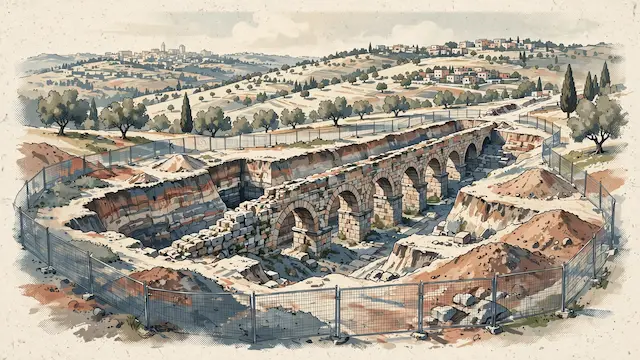
An impressive 300-meter section of the Lower Jerusalem Aqueduct, estimated to be 2,000 years old, has been unearthed during an archaeological excavation by the Israel Antiquities Authority (IAA) south of Kibbutz Ramat Rachel. The discovery was made in an area where the Israel Land Authority is promoting the construction of a new neighborhood.
The ancient aqueduct, believed to be a sophisticated engineering project from the Hasmonean period, was part of a larger water system that transported spring water from the Gush Etzion region and the Pools of Solomon all the way to the Temple Mount in Jerusalem. Excavation directors Dr. Benjamin Sturchan and Gil Fried from the IAA described it as a remarkable feat of engineering, so well-designed that it remained in intermittent use until about 100 years ago.
The aqueduct, originally spanning approximately 21 kilometers, was engineered to carry water via gravity alone, maintaining a precise gradient of one meter per kilometer. Its route was carefully adapted to the terrain, with inspection points along its length for maintenance and cleaning.
The unearthed section reveals different historical phases of the water system. Initially, water flowed through a plastered channel. During the Ottoman period, about 500 years ago, a ceramic pipe was laid within the original channel. The outer walls were plastered, and stones were embedded into the wet plaster to create a rough surface, reflecting ongoing efforts to maintain the water supply to the city.
Through cooperation between the Israel Land Authority and the IAA, this aqueduct segment is slated to be integrated as a living element into the main entrance of the new neighborhood, where it will be accessible to the public. Dr. Amit Ram, IAA's Director of the Jerusalem Region, highlighted its engineering brilliance and the IAA's vision, in partnership with the municipality, to create a continuous park allowing a walking route along the aqueduct from southern Jerusalem to the Old City.
The discovery will be presented at the 19th Conference on "Innovations in the Archaeology of Jerusalem and its Surroundings." Yehuda Eliyahu, Acting Director of the Israel Land Authority, stated that integrating the antiquities into the neighborhood will provide residents with a direct connection to the city's rich history.
Mentioned