Breaking· Culture· Updated
2,000-Year-Old Hasmonean Aqueduct Section Uncovered Near Jerusalem
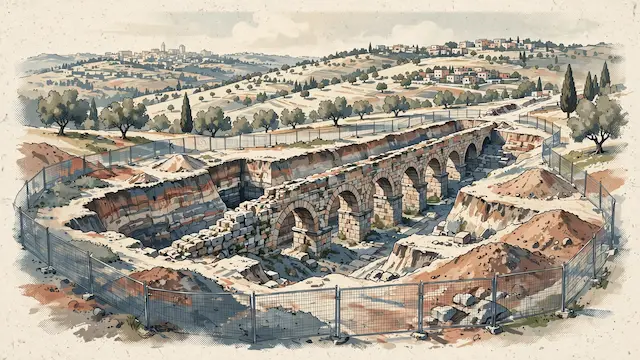
Archaeologists in Jerusalem have uncovered a 300-meter section of a 2,000-year-old aqueduct south of Kibbutz Ramat Rachel. The discovery was made during excavations by the Israel Antiquities Authority on land slated for a new residential neighborhood being developed by the Israel Land Authority.
4 newsrooms · 2 languages · since



What happened
- 01A 300-meter section of a 2,000-year-old Hasmonean aqueduct was discovered south of Kibbutz Ramat Rachel in Jerusalem.
- 02The discovery was made during excavations for a new residential neighborhood being developed by the Israel Land Authority.
- 03The aqueduct was part of a 21-kilometer system that transported water from Solomon's Pools to Jerusalem and the Temple Mount.
- 04The ancient engineering system relied entirely on gravity, utilizing a gentle gradient of one meter per kilometer.
- 05Excavations revealed Ottoman-period modifications, including a ceramic pipe laid inside the original plastered stone channel.
- 06The Israel Antiquities Authority plans to preserve the segment and integrate it into the entrance of the new neighborhood.
- 07Plans are underway to create an archaeological park allowing public access along the aqueduct to the Old City.
- 08The findings will be presented at the 19th Conference on Innovations in Jerusalem Archaeology.
Believed to have been constructed during the Hasmonean dynasty, the Lower Aqueduct was part of an ancient engineering system that transported water from Solomon's Pools south of Bethlehem to Jerusalem and the Temple Mount. The original 21-kilometer system relied entirely on gravity, utilizing a gentle gradient of about one meter per kilometer to move water without pumps.
The excavation revealed multiple repair and reconstruction phases, showing that the aqueduct was used intermittently for centuries until about 100 years ago. Initially, water flowed through a plastered stone channel, but during the Ottoman period about 500 years ago, a ceramic pipe was laid within the ancient channel and the exterior wall was covered with a rough plaster.
The Israel Antiquities Authority plans to preserve the unearthed segment and integrate it into the entrance of the new neighborhood. Future plans include creating an archaeological park that will allow the public to walk along the ancient water system from southern Jerusalem to the Old City. The findings will be presented at the 19th Conference on Innovations in Jerusalem Archaeology.
Summarized by baba from the reports of 3 newsrooms. Updated
Latest report: Kipa. Read Kipa’s originalThe coverage
4 newsrooms on this story
Who covered it
- LeftNone
- Centre1
- Right2
- HarediNone
- ArabNone
- Other1