2,000-Year-Old Hasmonean Aqueduct Section Uncovered Near Jerusalem
Translated & summarized from Kipa by baba
Archaeologists have uncovered a 300-meter section of a 2,000-year-old Hasmonean-era aqueduct near Jerusalem. The aqueduct, which carried water from Solomon's Pools, shows modifications from the Ottoman period, including a clay pipe. The find will be integrated into a new neighborhood's entrance and is part of a larger plan for a park along the ancient water route. The discovery will be presented at an upcoming archaeology conference.
The story in 6 lines · by baba
- A 300-meter section of a 2,000-year-old Hasmonean aqueduct was discovered south of Kibbutz Ramat Rachel.
- The aqueduct originally transported water from Solomon's Pools to Jerusalem and the Temple Mount.
- The system was modified during the Ottoman period with the installation of a clay pipe.
- The unearthed section will be incorporated into the entrance of a new neighborhood.
- Plans are underway for a park allowing a walk along the aqueduct from the city's south to the Old City.
- The discovery will be presented at the 19th Conference on Innovations in Jerusalem Archaeology.
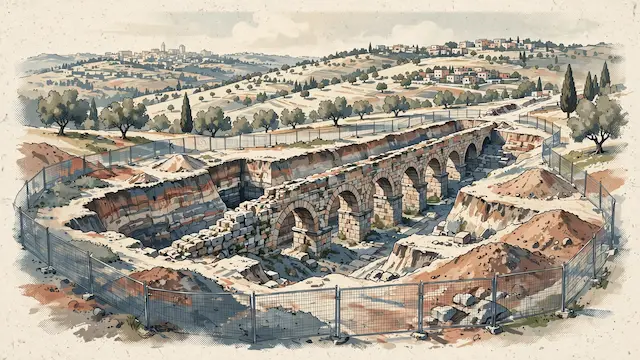
An approximately 300-meter section of the Lower Jerusalem Aqueduct, believed to have been constructed during the Hasmonean period, has been unearthed during archaeological excavations south of Kibbutz Ramat Rachel. The discovery was made by the Israel Antiquities Authority in an area where the Israel Land Authority is developing a new neighborhood. The aqueduct, part of a complex engineering system that transported water from the Solomon's Pools south of Bethlehem to Jerusalem and the Temple Mount, originally spanned about 21 kilometers and relied on gravity for water flow.
According to excavation directors Dr. Benjamin Sturchen and Gil Fried, the aqueduct was likely built by the Hasmonean kings but continued to serve Jerusalem intermittently for various periods until about 100 years ago. The system included inspection points for cleaning and maintenance. The unearthed findings document changes to the water system over time, initially featuring a plastered channel. Approximately 500 years ago, during the Ottoman period, a clay pipe was installed within the ancient channel, and the outer wall was plastered with stones embedded in the wet plaster, creating a distinctive rough surface.
The discovered section will be integrated into the main entrance of the new neighborhood, allowing public access and viewing. The Israel Antiquities Authority is also collaborating with the Jerusalem Municipality and other entities on a vision for a continuous park that would allow a walking path along the aqueduct from the southern edge of the city to the Old City.
The discovery is set to be presented this week at the 19th Conference on "Innovations in the Archaeology of Jerusalem and its Environs," organized by the Israel Antiquities Authority, Tel Aviv University, the Hebrew University, and the "Tiglath" Institute for Archaeology.
Mentioned