Ancient Jerusalem Aqueduct Section Found During Construction Dig
Translated & summarized from NEWSru Israel by baba
Archaeologists in Jerusalem discovered a 300-meter section of a nearly 2,000-year-old aqueduct south of the Ramat Rachel kibbutz. The structure, part of the Lower Aqueduct system, supplied the city with water for centuries and shows evidence of multiple repair phases. The Israel Antiquities Authority plans to preserve the section and integrate it into a new residential neighborhood, with future plans for an archaeological park. The findings will be presented at a conference this week.
The story in 6 lines · by baba
- A 300-meter section of a nearly 2,000-year-old aqueduct was discovered in Jerusalem.
- The aqueduct, part of the Lower Aqueduct system, supplied water to the city for centuries.
- The structure dates back to the Hasmonean era and shows evidence of Ottoman-period repairs.
- The discovery was made during excavations for a new residential neighborhood.
- The Israel Antiquities Authority plans to preserve and display the aqueduct section.
- Future plans include creating an archaeological park along the ancient water system.
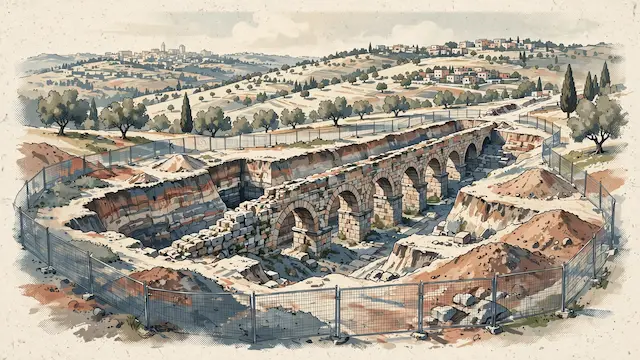
Archaeologists in Jerusalem have unearthed a 300-meter section of an ancient aqueduct, believed to be nearly 2,000 years old, south of the Ramat Rachel kibbutz. The structure, attributed to the Hasmonean era, was part of Jerusalem's Lower Aqueduct system, which supplied the city with water from springs near Gush Etzion and Solomon's Pools for almost two millennia. The discovery was made during excavations on land slated for a new residential neighborhood. The Lower Aqueduct, stretching approximately 21 kilometers, was a remarkable feat of ancient engineering, designed with a minimal gradient of one meter per kilometer to allow water to flow by gravity. It supplied water to various parts of the city, including the Temple Mount. Evidence of multiple repair and reconstruction phases was found along the unearthed segment. Initially, water flowed through a plastered stone channel. Around 500 years ago, during the Ottoman period, a ceramic pipe was laid within the ancient channel, and the exterior wall was covered with a distinctive rough plaster. The extensive repairs highlight the aqueduct's enduring importance for Jerusalem's water supply over centuries. Officials from the Israel Antiquities Authority expressed admiration for the ancient engineers' capabilities and plan to preserve the discovered section. It will be integrated into the new residential project's design, accessible to the public near the neighborhood's main entrance. The authority also aims to create an archaeological park extending from the southern part of the city to the Old City. The findings will be presented at the 19th conference "New Discoveries in the Archaeology of Jerusalem and its Vicinity" this week.
Mentioned