
2000-Year-Old Aqueduct Section Discovered in Jerusalem
Translated & summarized from Mignews by baba
Archaeologists in Jerusalem have discovered a 300-meter segment of the ancient Lower Aqueduct, dating back 2,000 years. The aqueduct, built during the Hasmonean era, supplied water to the city until the early 20th century. Plans are in place to integrate the preserved section into a new urban park for public access. The discovery was made ahead of new residential construction.
The story in 5 lines · by baba
- Archaeologists in Jerusalem found a 300-meter section of a 2,000-year-old aqueduct.
- The ancient Lower Aqueduct supplied water to the city from the Hasmonean period until the early 20th century.
- The discovered section will be preserved and integrated into a new urban park.
- The find occurred during excavations for a new residential neighborhood.
- The aqueduct was repaired and used across Roman, Byzantine, and Ottoman periods.
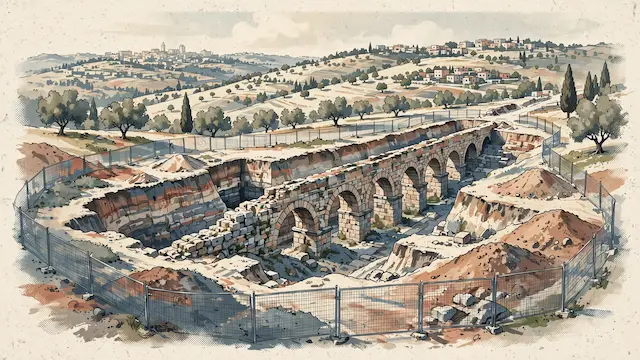
Israeli archaeologists have unearthed a 300-meter section of the ancient Lower Aqueduct in Jerusalem, a vital engineering system that supplied water to the city for centuries. The discovery was made by the Israel Antiquities Authority during excavations preceding the construction of a new residential neighborhood on the city's outskirts. The aqueduct, initially built during the Hasmonean period, remained operational, with intermittent use, until the early 20th century. It channeled water from natural springs south of the Bethlehem hills to Jerusalem and the Temple Mount. Benyamin Storchan, head of the excavations, highlighted the unique aspect of this find: the section will be integrated into a new urban park, making it accessible to both locals and tourists. Municipal authorities and archaeologists collaborated to adjust development plans to preserve the historical structure. Prior to the aqueduct, ancient Jerusalem relied on local springs and rainwater, but population growth and increased pilgrimage necessitated long-distance water transport. The aqueduct's resilience is evident in its continuous repairs and use across various historical periods, including Roman, Byzantine, and Ottoman eras. Modern dating techniques are expected to provide a more precise timeline of its construction and restoration phases.
Mentioned
The same event, reported separately by each outlet. Open a few to compare what different newsrooms emphasize — and what they leave out.
Left 2Centre 4Right 6Haredi 1Other 2













