Israel's Student Performance Plummets in International PISA Tests
Translated & summarized from Walla by baba
New PISA 2025 test results show a dramatic decline in Israeli students' performance in reading, math, and science, with scores dropping significantly below OECD averages. The results highlight widespread underperformance and a lack of preparedness in digital learning, prompting calls for urgent national intervention.
The story in 5 lines · by baba
- Israeli students' PISA scores dropped sharply in reading, math, and science.
- Declines in Israel are significantly worse than the OECD average.
- Nearly 30% of Israeli students lack basic proficiency in core subjects.
- Israel lags behind in digital learning preparedness despite AI usage.
- Parents attribute the decline to pandemic and war-related disruptions.
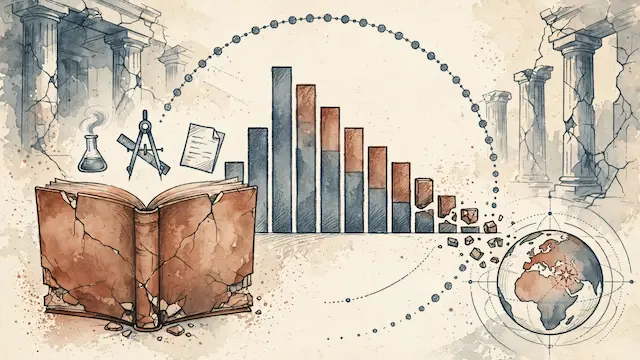
Recent results from the 2025 PISA tests reveal a significant decline in the academic performance of Israeli students. Over a three-year period, scores dropped by 38 points in reading, 25 in mathematics, and 23 in science. These declines are considerably steeper than the OECD average, placing Israel among countries with the most dramatic deteriorations.
In reading, Israel experienced the second-largest drop among comparable countries, falling 38 points, surpassed only by Latvia's 45-point decrease. In mathematics, Israel's 25-point decline matches Slovenia's, with Malta showing the largest drop. For science, Israel's 23-point decrease ranks it third in decline magnitude, behind Latvia and Hong Kong.
The current achievement levels reflect these drops. Fifteen-year-old Israeli students scored an average of 442 in science, 436 in reading, and 433 in mathematics, all below the OECD averages. In computer-based problem-solving, Israel's score of 444 is also significantly lower than the developed countries' average of 500. Furthermore, 29% of Israeli students fall below the basic proficiency level in all three core subjects, compared to the OECD average of 19.7%.
While girls outperformed boys in reading and science, the gap in mathematics was negligible. The report also highlighted that Israeli students are faster to provide incorrect answers in reading tasks compared to their OECD peers. Socially, the gap between the highest and lowest socioeconomic quartiles in science widened slightly, though the performance of the highest quartile students dropped significantly.
Regarding artificial intelligence, Israeli students use AI for learning slightly more than the OECD average. However, Israel ranks poorly in its educational system's preparedness for digital learning, scoring below the OECD average and placing 28th out of 37 countries in its ability to use digital tools to enhance teaching and learning.
The Parents' Association described the results as an "urgent alarm" for the education system, attributing the decline to the cumulative impact of the COVID-19 pandemic, security operations, and the ongoing war, which have disrupted students' learning and emotional well-being. They called for a national plan to address the learning gaps and deficiencies.
Mentioned
The same event, reported separately by each outlet. Open a few to compare what different newsrooms emphasize — and what they leave out.
Left 2Centre 9Right 3Arab 3Other 9