Nearly All Israeli Desalination Plants Shut Down Due to Murky Water
Translated & summarized from Now 14 by baba
Nearly all of Israel's desalination plants have shut down due to unusually murky seawater, likely originating from Egypt's Nile Delta. While drinking water supply is expected to continue, agricultural and public uses will be significantly reduced.
The story in 5 lines · by baba
- Most Israeli desalination plants stopped due to murky seawater.
- Murky water likely originated from Egypt's Nile Delta.
- Drinking water supply to homes is expected to continue.
- Water for agriculture and gardening will be significantly reduced.
- Only the Hadera desalination plant remains operational.
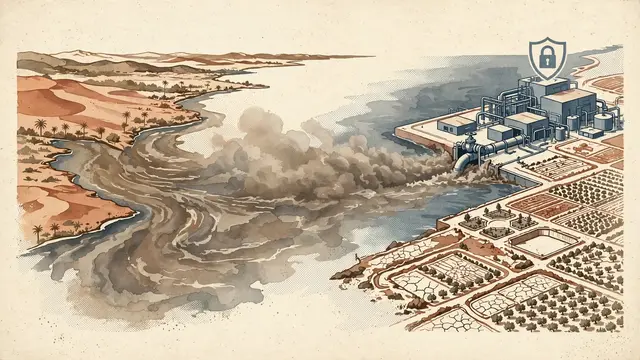
Almost all of Israel's Mediterranean desalination plants were forced to halt operations again on Tuesday, following an attempt to gradually resume activity overnight. The shutdown was caused by a sharp increase in seawater turbidity, attributed to a murky wave originating from the Nile Delta region in Egypt. Currently, only the Hadera desalination plant remains operational.
Initial investigations by the Israel Oceanographic and Limnological Research Institute suggest the turbidity may be due to a micro-algae bloom near the Nile Delta, carried to southern Israel by sea currents. Water Authority officials are continuing to investigate the phenomenon's source and its impact on the plants.
Despite the plant shutdowns, the Water Authority and the Ministry of Energy and Infrastructure assure the public that drinking water supplies to homes will continue. However, localized drops in water pressure and temporary supply disruptions may occur in some areas. No warning has been issued regarding the safety of tap water, as the water supplied to homes continues to undergo necessary treatment and quality control.
To mitigate the impact of the reduced desalination capacity, the Water Authority has ordered a significant reduction in water supply for agriculture, public gardening, and other non-essential public uses. Mekorot, the national water company, is increasing production from other available sources. Farmers, particularly in southern communities near the Egyptian border, have expressed concern that prolonged restrictions could damage crops and agricultural investments.
The consequences of the event are already being felt, with reports of low water pressure in Sderot and irrigation supply stoppages. The National Emergency Management Authority has also warned of potential disruptions in the Jerusalem area, Judea and Samaria, Ma'ale Adumim, and Beit Shemesh. The issue began on Monday, when severe turbidity caused five desalination plants, including those in Ashkelon, Ashdod, Palmahim, and two in Sorek, to cease operations. The possibility of a cyberattack was investigated but ruled out by the National Cyber Directorate and industry officials, with the current cause identified as environmental.
Mentioned
The same event, reported separately by each outlet. Open a few to compare what different newsrooms emphasize — and what they leave out.
Left 1Centre 5Right 2Haredi 2Other 5