
Israeli Election Stalemate: Potential Government Scenarios Explored
Translated & summarized from N12 by baba
Following Israel's election results, neither the "Change bloc" nor Prime Minister Benjamin Netanyahu's bloc has secured a majority to form a government, leading to a political stalemate. Potential scenarios include a narrow "Change bloc" government with Ra'am's support, or Netanyahu attempting to bring parties from the "Change bloc" into his coalition, which would require significant concessions. The ultra-Orthodox party United Torah Judaism has also hinted at potentially supporting a "Change bloc" government externally. Initial meetings between leaders from the "Change bloc" have begun to explore forming a government.
The story in 5 lines · by baba
- Israel faces a political deadlock after elections, with no bloc securing a 61-seat majority to form a government.
- A narrow "Change bloc" government could be formed with support from Ra'am, totaling 56 seats.
- Prime Minister Netanyahu might try to form a government by attracting parties from the "Change bloc."
- United Torah Judaism suggested it could support a "Change bloc" government externally.
- Leaders from the "Change bloc" have begun initial meetings to discuss government formation.
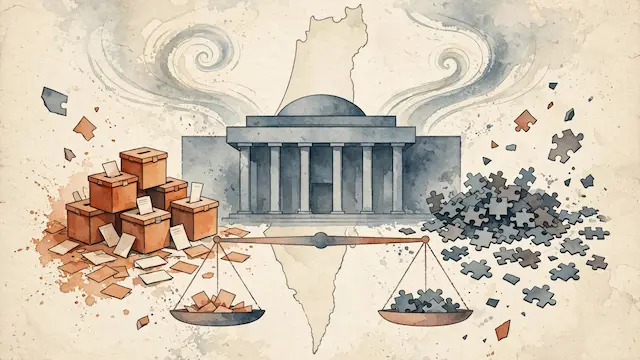
Following the final election results, Israel finds itself in a political deadlock, with neither the "Change bloc" nor Prime Minister Benjamin Netanyahu's bloc securing the 61 Knesset seats needed to form a government. Several potential scenarios are being considered to avoid another election.
One possibility is a narrow "Change bloc" government supported by Ra'am, the Arab Islamist party. This bloc, comprising Gadi Eisenkot, Naftali Bennett, Yair Golan, and Avigdor Lieberman, has 48 seats. With Ra'am's 8 seats, they could reach 56, a majority over Netanyahu's 53-seat bloc. However, this scenario would require Ra'am's active support on legislation and could involve breaking election promises, particularly for Lieberman. Netanyahu is reportedly planning a de-legitimization campaign against Ra'am, alleging pre-election fraud. Despite this, Ra'am's leader, Mansour Abbas, has expressed skepticism about the viability of a minority government, citing potential difficulties in negotiating with the Arab Joint List, including the anti-Israel stance of Balad.
Another scenario involves Netanyahu forming a government by bringing in one or more parties from the "Change bloc." For instance, Bennett and Lieberman together would add 14 seats, potentially reaching 67. However, Bennett and Lieberman alone would only bring 60 seats, insufficient for a majority. Such a move would likely require Netanyahu to make significant concessions and potentially distance himself from his current natural partners. Lieberman has publicly stated he would not sit with Netanyahu or Tibi, advocating for a coalition of only Zionist parties, including the Likud without Netanyahu. Meanwhile, Bezalel Smotrich met with Netanyahu to coordinate joint moves.
A less discussed option is a "Change bloc" government with the external support of United Torah Judaism (UTJ). UTJ has indicated that Netanyahu cannot meet their demands and has suggested they might support Eisenkot and the "Change bloc" from the outside. They are reportedly seeking assurances on budgets and the ultra-Orthodox draft issue. Sources within UTJ suggest their alliance with Netanyahu has expired, and they aim to be a decisive factor in the Knesset. Some believe that behind-the-scenes negotiations could lead to a draft law acceptable to both sides. However, UTJ Chairman Yaakov Asher stated there are no current overtures, pending instructions from their rabbinical leadership.
Despite no official coalition talks having begun, initial political meetings have taken place. Eisenkot and Bennett met to discuss forming a government quickly. Eisenkot also met with Yair Golan and opposition leader Yair Lapid. Golan, in turn, met with Mansour Abbas to explore possibilities for a "government of repair and salvation for Israel."
Mentioned
The same event, reported separately by each outlet. Open a few to compare what different newsrooms emphasize — and what they leave out.
Centre 4Right 1Arab 1





Not the same event — other stories that share this one’s people, places, or theme: background, reactions, and follow-ups.




