
Israeli Election Stalemate Fuels Political Uncertainty and New Knesset Maneuvers
Translated & summarized from Mako by baba
Israel faces a prolonged period of political uncertainty following the 26th Knesset elections, as neither Prime Minister Benjamin Netanyahu's bloc nor the opposition 'Change bloc' secured a majority to form a government. Both sides succeeded in blocking the other but failed to achieve their primary objectives. The opposition is exploring maneuvers within the Knesset, such as replacing the Speaker, while Netanyahu may leverage time and internal divisions. The possibility of repeat elections looms, with neither outcome guaranteed to resolve the deep political divisions.
The story in 6 lines · by baba
- Israeli elections resulted in a deadlock, with neither Benjamin Netanyahu's bloc nor the opposition able to form a government.
- Prime Minister Netanyahu prevented the opposition from gaining a majority but failed to secure enough seats for his own coalition.
- The opposition bloc, led by Gadi Eisenkot, blocked Netanyahu but could not achieve its goal of replacing him.
- The opposition is considering Knesset maneuvers, including replacing the Speaker, to influence the agenda.
- A prolonged period of political uncertainty and the possibility of repeat elections are anticipated.
- Both blocs are exploring strategies to gain an advantage amidst the ongoing political stalemate.
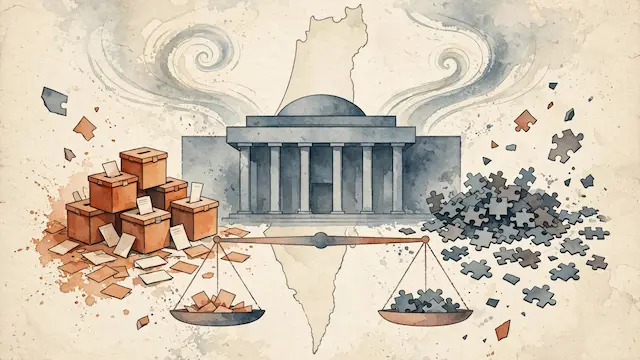
Israel's 26th Knesset elections concluded without a clear victor, leaving both Prime Minister Benjamin Netanyahu's bloc and the opposition 'Change bloc' unable to form a government. Netanyahu succeeded in preventing the opposition from securing a majority to replace him, but he also failed to achieve the 61 seats needed for his own coalition. The opposition, led by Gadi Eisenkot, managed to block Netanyahu's path to a majority but fell short of its goal to oust him from power. This deadlock creates a paradox where each side can thwart the other, potentially leading to a prolonged political crisis and the possibility of repeat elections.
Netanyahu's Likud emerged as the largest party, but his strategic failure lies in managing his bloc's coalition-building capabilities. He benefits from time, continuing as interim prime minister, and can explore options like fracturing the opposition, enticing potential defectors, or campaigning against Arab party alliances. He may also be preparing for another election round, viewing it not as an insurmountable threat but as a potential opportunity.
The Change bloc, despite organizational successes like four parties passing the electoral threshold with minimal vote wastage, faces challenges. Questions linger about whether they focused enough on expanding their base rather than internal competition. The political alliance between Naftali Bennett and Yair Lapid may have blurred Bennett's ability to present a right-wing alternative. Eisenkot's campaign, while solidifying his leadership, intensified internal rivalry and diverted attention from broader coalition efforts. Yair Golan's stance on Arab parties is also under scrutiny, with an estimated loss of two mandates due to his support for disqualifying Balad Chairman Sami Abu Shehadeh.
A unity government is seen as a potential solution to the impasse, but it faces significant hurdles. Opposition leaders who campaigned to replace Netanyahu may find joining his government a betrayal of their voters. Past experiences, particularly Benny Gantz's political cost from previous collaborations with Netanyahu, loom large. Netanyahu's camp is reportedly trying to persuade Bennett to break from Lapid, but this faces challenges, including insufficient mandates and potential alienation from his own base and the Netanyahu family.
As forming a government appears distant, the Change bloc is exploring alternative strategies within the Knesset. A key move under consideration is replacing Knesset Speaker Amir Ohana, which could grant the opposition significant influence over the parliamentary agenda, committee compositions, and legislative initiatives. This includes advancing a new conscription law, establishing a state inquiry commission for the October 7th events, and potentially repealing judicial overhaul laws. This strategy aims to reshape the political reality without immediately forming a government.
Netanyahu's counter-strategy involves delegitimizing any cooperation with Arab parties, portraying it as treason, and attempting to divide the Change bloc internally. If these efforts fail, repeat elections remain a possibility. However, both blocs recognize that new elections do not guarantee a different outcome, as the underlying ideological and demographic divisions persist. The period ahead is expected to be marked by prolonged political uncertainty, maneuvering for mandates, pressure campaigns, and potential shifts in Knesset control, all while Israel grapples with pressing security, economic, and social challenges.
Mentioned
The same event, reported separately by each outlet. Open a few to compare what different newsrooms emphasize — and what they leave out.
Centre 4Right 1Arab 1





Not the same event — other stories that share this one’s people, places, or theme: background, reactions, and follow-ups.




