Israel Election Deadlock: Netanyahu and Eisenkot Seek Coalition Partners Amidst Uncounted Votes
Translated & summarized from Jüdische Allgemeine by baba
Israel's parliamentary election has resulted in a deadlock, with Prime Minister Benjamin Netanyahu's bloc leading but lacking a clear majority. Challenger Gadi Eisenkot also faces challenges in forming a government. Vote counting is ongoing, and Netanyahu's Likud party has alleged widespread electoral fraud. President Isaac Herzog will ultimately task a lawmaker with forming a coalition, urging openness to avoid new elections. The election outcome comes amidst ongoing concerns about threats from Iran.
The story in 6 lines · by baba
- Israel's parliamentary election results in a deadlock, with no clear majority for government formation.
- Prime Minister Benjamin Netanyahu's bloc leads, but requires further coalition talks with potential partners.
- Opposition leader Gadi Eisenkot also seeks to form a "Zionist government" with a focus on conscription.
- Netanyahu's Likud party alleges massive electoral fraud by Arab parties.
- Arab parties secured 19 seats and could play a kingmaker role in coalition building.
- President Isaac Herzog will appoint a lawmaker to form a government, urging parties to avoid new elections.
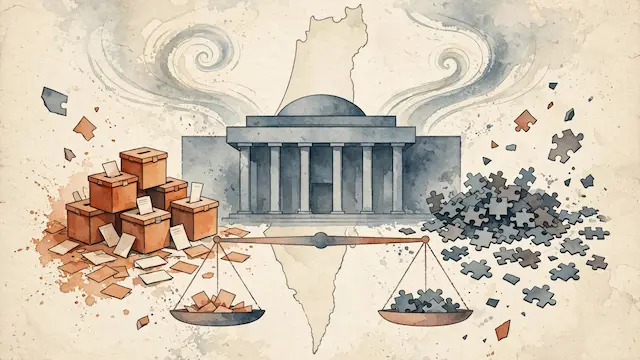
Following Israel's parliamentary elections, Prime Minister Benjamin Netanyahu and his challenger Gadi Eisenkot have begun preliminary discussions with potential coalition partners. While Netanyahu's right-religious bloc appears to be leading after most votes are counted, a clear majority for forming a government has not yet emerged. The preliminary official results are expected today.
Netanyahu has reportedly spoken with Bezalel Smotrich, chairman of the Religious Zionism party, and Itamar Ben-Gvir, chairman of the far-right Otzma Yehudit party, both of whom are currently part of the government. Netanyahu also plans to engage with ultra-Orthodox parties. Despite the election taking place on Tuesday, vote counting is still ongoing. With approximately 90% of votes tallied, Netanyahu's bloc secured 53 out of 120 parliamentary seats, while Eisenkot's center-right bloc obtained 48 seats.
Eisenkot, despite his bloc also not having a clear majority, has affirmed his commitment to political change, aiming to form a "Zionist government" that would include conscription for ultra-Orthodox men. He stated that voters had expressed distrust in the current government, which he holds responsible for draft evasion and the October 7th massacre. Eisenkot acknowledged the weight of responsibility and the trust placed in him by hundreds of thousands of citizens.
Netanyahu's Likud party saw a decrease in seats compared to the previous election in November 2022 but remained the largest party. Arab parties, which performed strongly in this election, could play a crucial role in government formation, collectively securing 19 seats according to the latest count. Former Prime Minister Ehud Olmert suggested that the opposition alliance needs the courage to approach the Arab parties, expressing confidence in their willingness to join an Israeli government.
Netanyahu's party has alleged massive electoral fraud by Arab parties, claiming they support terrorism and the destruction of the Jewish state. The Likud party submitted evidence of alleged offenses, including bribery, threats, violence, and the use of prohibited software, to the police, Shin Bet, and the Central Elections Committee, demanding a thorough investigation. The party asserted that the integrity of the elections was "massively compromised."
The Central Elections Committee stated it would review the complaint, a standard procedure for addressing alleged irregularities. The final official results are legally due within eight days of the election. Subsequently, President Isaac Herzog will consult with parliamentary parties and task a lawmaker with forming a government, prioritizing the one most likely to build a majority coalition. Herzog urged parties to show openness to avoid further elections due to the deadlock.
Netanyahu also highlighted the ongoing threat from Iran, emphasizing the need for Israel and the U.S. to "eliminate this threat once and for all." Reports suggest the U.S. is exploring diplomatic avenues to avert planned military strikes against Iran, potentially involving Arab Gulf states.
Mentioned
The same event, reported separately by each outlet. Open a few to compare what different newsrooms emphasize — and what they leave out.
Centre 3Arab 1



Not the same event — other stories that share this one’s people, places, or theme: background, reactions, and follow-ups.


