
Israeli Election Stalemate Leaves Netanyahu Without Clear Majority
Translated & summarized from Channel 13 by baba
Following Israeli elections, Prime Minister Benjamin Netanyahu's bloc leads but lacks a clear majority, creating a political stalemate. The "change bloc" also cannot form a government, raising possibilities of a minority government or new elections. The counting of soldiers' votes, expected to conclude Thursday evening, may shift a few mandates but is unlikely to break the deadlock. The political uncertainty continues as parties weigh options for government formation.
The story in 6 lines · by baba
- Israeli elections result in a political stalemate with no clear majority for any bloc.
- Prime Minister Benjamin Netanyahu's bloc leads but lacks the votes to form a government.
- The "change bloc" is also unable to form a government, complicating coalition possibilities.
- A minority government relying on Arab parties is a complex and problematic scenario.
- The counting of soldiers' votes is underway and expected to conclude Thursday evening.
- Another election round is a possibility, potentially benefiting Netanyahu if it occurs.
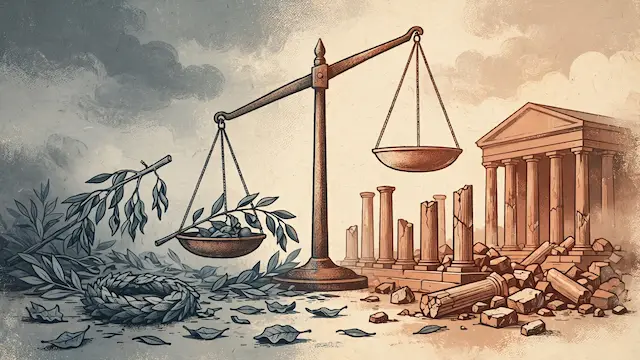
Following the recent elections, Israel finds itself in a familiar political deadlock, with no clear victor and numerous unanswered questions. While Prime Minister Benjamin Netanyahu's bloc initially held a lead after vote counting overnight and into the morning, he has lost the significant majority he commanded in the outgoing Knesset and currently lacks a path to forming a government. A notable outcome, however, is that a majority of voters expressed distrust in the "October 7th government." With 85% of votes tallied, there are more Knesset members opposing Netanyahu than supporting him. Nevertheless, the situation remains complex as the "change bloc" is also far from forming a government, and the scenario of a minority government relying on Arab parties presents significant challenges.
This impasse revives the recurring question of whether Israel is headed for another election, a unity government, or a new political arrangement being secretly negotiated. The prevailing assumption is that another election round would benefit Netanyahu. This perception might lead the "change bloc" to face difficult decisions, while Netanyahu could adopt a passive strategy, delaying tactics with the expectation of winning a future election. Eisenkot and Yair Golan are reportedly exploring possibilities for a government involving Arab parties, a move that would require the approval of Avigdor Lieberman and Naftali Bennett. Such a coalition would contradict their election promises and could raise concerns about further elections within a year, potentially with Netanyahu returning stronger.
The Central Elections Committee reported that between 430,000 and 480,000 "double envelopes" containing votes from soldiers and others will be counted, representing approximately 9% of the total electorate. In 2022, about a quarter of these votes went to Netanyahu's Likud, but "Yesh Atid" and "Religious Zionism" also received significant support. Parties with fewer soldiers among their supporters, such as "United Torah Judaism," the Joint List, and Ra'am, might lose a mandate from this count. For Yoaz Hendel and Yaron Zelicha's parties, which are currently short of the electoral threshold, they would need about 12% of the double envelope votes to pass, a figure significantly higher than their current national average and seemingly difficult to achieve.
It is anticipated that the double envelopes will shift two to three mandates but are unlikely to decisively alter the balance between the blocs, thus not providing a clear electoral outcome. The Central Elections Committee stated that internal ballots are separated from outer envelopes to ensure voter anonymity before being moved to the counting area at the Knesset. The vote count is expected to commence around 1:00 AM and conclude by the evening of Thursday, October 29th.
Mentioned
The same event, reported separately by each outlet. Open a few to compare what different newsrooms emphasize — and what they leave out.
Centre 6Right 2Haredi 1Arab 3Other 2












Not the same event — other stories that share this one’s people, places, or theme: background, reactions, and follow-ups.



