
Invasive Ant Species, Among World's Most Dangerous, Discovered in Israel
Translated & summarized from Makan by baba
Israel's Ministry of Environmental Protection confirmed the discovery of the African big-headed ant, one of the world's most dangerous invasive species, in Haifa. The ants pose a significant threat to local ecosystems and agriculture, with authorities studying control methods. The public is asked to report sightings to help limit the species' spread.
The story in 5 lines · by baba
- An invasive African big-headed ant species, among the world's 100 most dangerous, has been discovered in Haifa, Israel.
- The species poses a severe threat to ecosystems and the agricultural sector in Israel.
- The Ministry of Environmental Protection is investigating its spread and developing control methods.
- The public is encouraged to report sightings to help contain the ant's expansion.
- The ant is known for its high reproductive rate and ability to form extensive networks of nests.
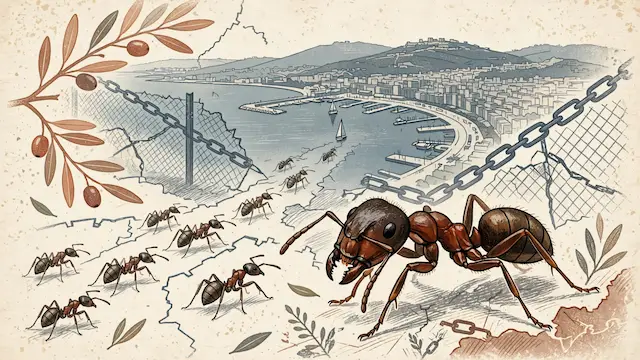
Israel's Ministry of Environmental Protection announced on Thursday the discovery of an invasive ant species in the country, classified among the world's 100 most dangerous invasive species due to potential severe damage to ecosystems and agriculture. The ministry identified the species as the African big-headed ant, recently observed in the Neve Sha'anan neighborhood of Haifa. Authorities are investigating reports of its presence in other areas of the city.
Specialized teams are currently studying control methods suitable for local conditions. The public is urged to report any suspected sightings to aid in mapping the ant's spread and limiting its expansion. This species, originating from Africa, has spread globally to warm climates over recent years. It is named for the disproportionately large heads of its soldier ants.
The African big-headed ant is characterized by its high reproductive and dispersal capabilities. Colonies can contain multiple queens, and they form extensive networks of cooperating nests, making containment challenging. The ants feed on a varied diet including insects, seeds, and organic matter. They can spread unintentionally through the transport of infected plant pots, seedlings, soil, and pruning waste, similar to how other invasive species, like the little fire ant, have spread.
While not posing a direct health risk to humans, the ant's proliferation can disrupt ecological balance and harm agricultural crops. Early detection and reporting of its locations are therefore crucial for controlling its spread.
The same event, reported separately by each outlet. Open a few to compare what different newsrooms emphasize — and what they leave out.
Left 1Centre 4Right 3Haredi 2Arab 1Other 3














Not the same event — other stories that share this one’s people, places, or theme: background, reactions, and follow-ups.
