
Dangerous Invasive Ant Species Identified for First Time in Israel
Translated & summarized from Ice by baba
Israel's Ministry of Environmental Protection has confirmed the first detection of the invasive African big-headed ant in Haifa, a species considered among the world's most damaging. The ant, identified following resident reports, poses significant ecological and agricultural threats by displacing native species and harming crops. Authorities are collaborating on mapping, monitoring, and a pilot program to test control methods, while urging public vigilance for identification.
The story in 6 lines · by baba
- The African big-headed ant, a highly damaging invasive species, has been confirmed in Israel for the first time.
- The ant was first detected in Haifa's Neve Sha'anan neighborhood after reports from local residents.
- This invasive species poses significant ecological threats, displacing native ants and harming other wildlife.
- It can also cause agricultural damage by fostering and protecting plant pests.
- Authorities are conducting a pilot program to test effective pesticide treatments.
- Public assistance in reporting sightings is crucial for monitoring and control efforts.
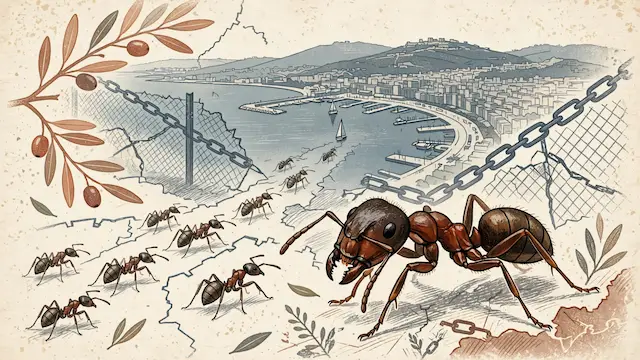
Israel's Ministry of Environmental Protection has confirmed the first detection of the African big-headed ant (Pheidole megacephala), an invasive species considered one of the world's 100 most damaging. The ant was initially identified in the Neve Sha'anan neighborhood of Haifa, specifically near Giv'at HaShoshanet and surrounding streets, following reports from residents. Investigations are also underway regarding potential sightings in the Hadar neighborhood.
The ministry is collaborating with the Haifa Municipality, Tel Aviv University, and other experts to map infestation sites, monitor the ant's spread, and develop control strategies to limit its presence and prevent further establishment. Native to Africa, this ant has spread globally, particularly in warm climates. Its workers are characterized by disproportionately large heads. The species reproduces and spreads rapidly, forming extensive networks of cooperating colonies, sometimes with multiple queens.
Feeding on a wide range of food sources, including insects, seeds, and organic matter, the big-headed ant can expand its territory through the unintentional transport of infested plants, soil, and cuttings, similar to the invasive little fire ant. Its establishment poses a significant threat to local ecosystems by displacing native ant species and harming other arthropods, snails, and slugs. It also preys on small vertebrates like bird nestlings, shrews, and reptiles, causing cascading ecological effects such as disrupting seed dispersal by native ants.
Furthermore, the ant can damage agriculture by fostering and protecting plant pests like aphids from their natural enemies. Its spread may also impact infrastructure. The Ministry of Environmental Protection stated that local authorities are responsible for managing pest nuisances in public areas. Consequently, the ministry is guiding the Haifa Municipality in expanding its monitoring and pest control efforts, providing professional support to identify new infestation sites, contain the ant's spread, and implement effective treatments.
The Haifa Municipality has initiated a pilot program, with guidance from the Ministry and Tel Aviv University, to test the efficacy of various pesticides against the invasive ant. Four affected plots are being used, each with a different pesticide, to determine the most effective treatment for Israel's climate and environment. Ministry representatives are weekly monitoring the pilot's progress. Mapping and monitoring efforts continue to identify additional infestation sites and assess the extent of its spread.
The Ministry has also issued public guidance for identifying the ant. Suspected presence can be indicated by numerous ants moving rapidly in dense trails, especially when small ants are seen alongside larger ones with exceptionally big heads, making up about a third of the ant's body length. The ants are brown (lighter in the middle, darker at the front and rear), measuring 2-3 millimeters, twice the size of the little fire ant. They are observed climbing trees, and their nests are characterized by high density on the ground, often surrounded by piles of dead, light-brown ants. However, due to the existence of similar-looking native ant species, definitive identification requires professional examination. Resident reports are crucial for identifying infestation sites and mapping the ant's distribution, enabling professionals to plan monitoring and control actions and reduce the risk of further spread.
Mentioned
The same event, reported separately by each outlet. Open a few to compare what different newsrooms emphasize — and what they leave out.
Left 1Centre 4Right 3Haredi 1Other 2











Not the same event — other stories that share this one’s people, places, or theme: background, reactions, and follow-ups.
