
Post-Election Uncertainty: Israel Faces Coalition Stalemate or New Vote
Translated & summarized from Maariv by baba
Following Israeli elections, the country faces a political deadlock with options including opposition parties joining Benjamin Netanyahu's government or new elections. Pre-election polls failed to predict the outcome accurately, particularly the Likud's performance and Arab voter turnout, leading to widespread disappointment. President Isaac Herzog is pushing for a unity government, but the fragmented political landscape and pledges from key figures make this difficult. The nation must now navigate coalition talks amidst regional tensions and potential international developments.
The story in 6 lines · by baba
- Israel faces a post-election dilemma: opposition joining Netanyahu's government or new elections.
- Pre-election polls inaccurately predicted the outcome, causing disappointment and questioning of methods.
- President Herzog is seeking a unity government, echoing his father's efforts in 1984.
- Netanyahu's campaign focused on fear-mongering, warning of sanctions and nuclear threats.
- Key figures like Gadi Eisenkot have refused to join a government led by Netanyahu.
- The political landscape is fragmented, making coalition formation a significant challenge.
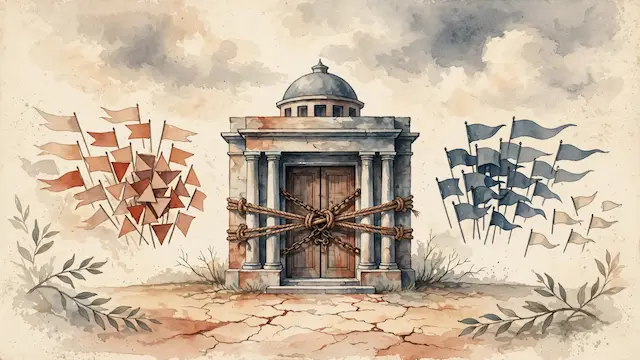
Following recent elections, Israel finds itself in a political quandary, with two primary scenarios emerging: either opposition parties will join a government led by Benjamin Netanyahu, or the country will face another election. Many Israelis had anticipated a clear victory for the "change bloc" based on wishful thinking and creative interpretations of pre-election polls that did not predict a decisive outcome.
Prime Minister Benjamin Netanyahu, in the final days of the campaign, employed a strategy of fear-mongering, warning of potential crippling economic sanctions and even a nuclear catastrophe if his rivals were to win. He also invoked historical and modern analogies, such as Sparta and cryptocurrency, to explain potential future challenges, though his messaging may have been lost on some of his supporters.
President Isaac Herzog is attempting to broker a unity government, a move reminiscent of his father, Chaim Herzog, in 1984. However, the current political landscape is far more fractured than in the past. Unlike the 1984 situation where two dominant parties held a significant majority, today's political blocs are more fragmented, making a broad unity government more challenging to form. Furthermore, key figures like Gadi Eisenkot have pledged not to join a Netanyahu-led government.
The article also delves into the perceived inaccuracies of pre-election polls, suggesting that the sampling methods used by many pollsters may not be effectively reflecting the reality on the ground. The surprising strength of the Likud party and the high turnout among the Arab sector were not accurately predicted by most polls, leading to disappointment and confusion among those who expected a different outcome.
As the political maneuvering continues, the upcoming US midterm elections and potential developments regarding Iran add further layers of complexity and urgency. The process of forming a government in Israel is lengthy, potentially extending for months, during which the country must navigate domestic political challenges alongside significant regional security concerns.
Mentioned
The same event, reported separately by each outlet. Open a few to compare what different newsrooms emphasize — and what they leave out.
Centre 2Right 1Other 1




Not the same event — other stories that share this one’s people, places, or theme: background, reactions, and follow-ups.




