
Israel Election Day: Three Scenarios for Next Government Formation
Translated & summarized from Now 14 by baba
Israelis are voting in the 26th Knesset elections, with three potential government formation scenarios emerging. The first is a right-wing government led by Benjamin Netanyahu, relying on a bloc of religious and right-wing parties. The second is an opposition-led government, possibly including parties like National Unity and Yesh Atid, facing ideological challenges. The third scenario is a political stalemate leading to repeat elections, a situation seen in previous years. The outcome may depend on leaders' willingness to cooperate post-election.
The story in 5 lines · by baba
- Three scenarios for forming Israel's next government are a right-wing bloc, an opposition coalition, or a repeat election.
- A right-wing government would likely be led by Benjamin Netanyahu and include Shas, United Torah Judaism, Otzma Yehudit, and Religious Zionism.
- An opposition government could involve parties like National Unity and Yesh Atid, but faces ideological hurdles and leadership questions.
- A political stalemate, similar to 2019-2022, could lead to another election if no bloc secures a majority.
- The election outcome may hinge on party leaders' willingness to cooperate after the votes are counted.
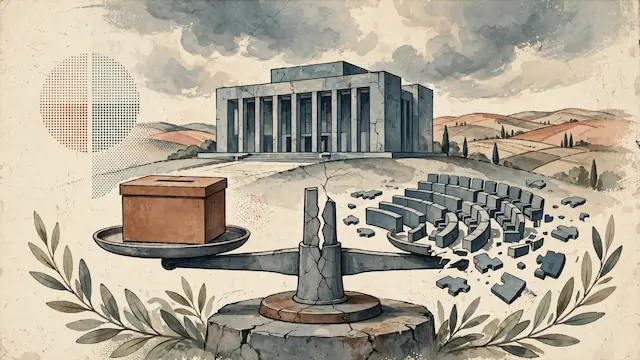
As Israelis head to the polls for the 26th Knesset elections on Tuesday, the political system is bracing for the post-election challenge of forming the next government. Three main scenarios are on the table, with the key question being not just which party will win the most votes, but which leader can assemble a coalition commanding Knesset confidence.
The first scenario envisions Prime Minister Benjamin Netanyahu forming a right-wing government. This would rely on a bloc including Likud, Shas, United Torah Judaism, Otzma Yehudit, and Religious Zionism-Tkuma. If these parties secure at least 61 seats, forming the government would be numerically simpler, though coalition negotiations on policy and ministerial portfolios would still be necessary. Netanyahu has emphasized his commitment to a right-wing government and continuing judicial reform. Key negotiation points would include the conscription law, policy in Judea and Samaria, the relationship between the government and the judiciary, and the distribution of senior positions. This scenario could also involve bringing in a party outside the outgoing coalition, provided it agrees with the new government's foundational principles, contingent on campaign pledges and potential partners' willingness to cooperate.
The second scenario involves the opposition forming a government. This could be led by parties such as National Unity, headed by Gadi Eisenkot, or Yamina, led by Naftali Bennett. Such a government might comprise several parties from the outgoing opposition, but securing the necessary majority is more complex. One discussed possibility includes National Unity, Yamina, Yesh Atid, and Yisrael Beiteinu, potentially seeking support from Ra'am or external backing from the Joint List. However, this option faces significant internal divisions due to ideological gaps and differing stances on partnering with Arab parties. The identity of the prime ministerial candidate could also be a hurdle, with Eisenkot and Bennett vying for leadership, requiring other key players to decide on their support and conditions.
The third scenario, familiar from the political deadlock of 2019-2022, is a stalemate where no bloc can form a government, leading to another election. This could occur if smaller parties fail to cross the electoral threshold, if neither bloc achieves a majority, or if mutual boycotts prevent agreements even after seat allocations. Following the election, party representatives will recommend a candidate to President Isaac Herzog, who will task the individual he believes has the best chance of success. If these attempts fail, the constitutional process could lead to new elections. Ultimately, the current election may be decided not just by vote counts, but by the willingness of party leaders to cooperate after election day.
Mentioned
The same event, reported separately by each outlet. Open a few to compare what different newsrooms emphasize — and what they leave out.
Coverage from Now 14
Not the same event — other stories that share this one’s people, places, or theme: background, reactions, and follow-ups.




