
Six Scenarios That Could Alter Israel's Election Results
Translated & summarized from Now 14 by baba
Six potential scenarios could alter the outcome of Israel's 26th Knesset elections, with just one day remaining. Key factors include voter turnout among right-wing and Arab communities, the performance of smaller parties like Ofer Winter's "Am Israel," and the ability of either the right-wing or opposition bloc to secure a 61-seat majority. If no bloc achieves a clear majority, negotiations will be crucial, potentially involving ultra-Orthodox and Arab parties. Gadi Eisenkot might attempt to form a minority government, possibly with Arab party abstentions, while Prime Minister Binyamin Netanyahu seeks a decisive win for his bloc.
The story in 6 lines · by baba
- Six scenarios could significantly alter the outcome of Israel's upcoming Knesset elections.
- Voter turnout in the Arab and right-wing communities is a critical factor.
- Smaller parties failing to cross the electoral threshold could cost blocs votes.
- A hung parliament could lead to complex negotiations involving Haredi and Arab parties.
- Gadi Eisenkot might attempt to form a minority government with Arab party abstentions.
- Prime Minister Netanyahu aims for a clear 61-seat majority for the right-wing bloc.
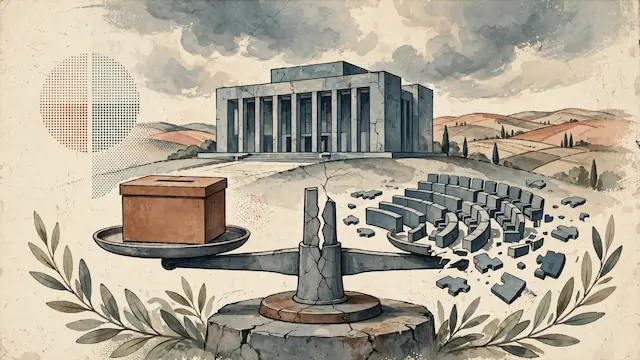
With just 24 hours until the 26th Knesset elections, the political landscape is bracing for six potential scenarios that could significantly impact the outcome and the formation of the next government. Prime Minister Binyamin Netanyahu is focused on securing a 61-seat majority for the right-wing bloc, while opposition leader Gadi Eisenkot and other opposition parties aim to prevent him from forming another government. The final results may hinge on turnout in various sectors, the fate of parties falling below the electoral threshold, and the distribution of votes between the blocs.
One key scenario involves a surge in turnout among right-wing voters, which could bolster Netanyahu's bloc. However, a major concern for the Likud is voter apathy, with fears that supporters may assume victory and stay home. A significant increase in voter turnout within the Arab community is another scenario that could dramatically shift the balance of power, potentially giving Arab parties 16 to 17 seats. Conversely, if the "Am Israel" party, led by Brigadier General (res.) Ofer Winter, fails to cross the 3.25% electoral threshold despite garnering tens of thousands of votes, those votes would be lost, potentially costing the right-wing bloc crucial seats.
Another possibility is that smaller parties successfully cross the electoral threshold, translating previously lost votes into parliamentary seats. The impact of these parties depends on which bloc their voters primarily come from. If no bloc achieves a clear 61-seat majority, the decision could fall to negotiations, with the ultra-Orthodox parties, such as United Torah Judaism led by Yaakov Asher, potentially playing a kingmaker role. Their stance is currently neutral, awaiting demands to be met, including the status of yeshiva students.
Furthermore, a significant strengthening of Gadi Eisenkot's National Unity Party, coupled with gains by other change bloc parties, could lead to a majority for the opposition. In a more complex scenario, Eisenkot might attempt to form a minority government, potentially relying on the abstention of Arab parties during confidence votes. This possibility was alluded to by Eisenkot himself, who stated he would form a government even with 58 or 59 seats if necessary. Reports also surfaced of Eisenkot promising to work towards including Ra'am, led by Mansour Abbas, in a future government, a claim strongly denied by National Unity.
The role of Arab parties, including Ta'al led by Ahmed Tibi, could be pivotal. Their abstention in a confidence vote could allow a minority government to pass, even without a full 61-seat majority. Active support from Arab parties, though not necessarily coalition membership, could also influence government formation. The outcome of the elections will determine parliamentary power, but the final decision on who heads the government may require extensive post-election negotiations.
Mentioned
The same event, reported separately by each outlet. Open a few to compare what different newsrooms emphasize — and what they leave out.
Coverage from Now 14
Not the same event — other stories that share this one’s people, places, or theme: background, reactions, and follow-ups.



