
Four Voters Could Sway Israeli Election Results, Pollster Warns
Translated & summarized from Al-Shams by baba
Four days before Israeli elections, pollster Menachem Lazar warned that results are highly sensitive, with a few votes potentially altering party standings. A recent poll shows the opposition bloc leading, but Lazar noted that parties close to the electoral threshold could significantly impact the final seat distribution. Factors like voter turnout and the reliability of poll responses, especially among young voters shaped by the war, remain unpredictable and could lead to outcomes differing from current projections.
The story in 5 lines · by baba
- Pollster Menachem Lazar warns that only a few votes could determine if parties cross Israel's electoral threshold.
- A recent poll shows the opposition bloc leading with 54 seats versus the coalition's 48.
- The performance of parties near the electoral threshold could significantly change the final seat distribution.
- Voter turnout and the accuracy of poll responses are unpredictable factors that may affect election results.
- Young voters' behavior, influenced by the ongoing war, may differ from previous generations, Lazar noted.
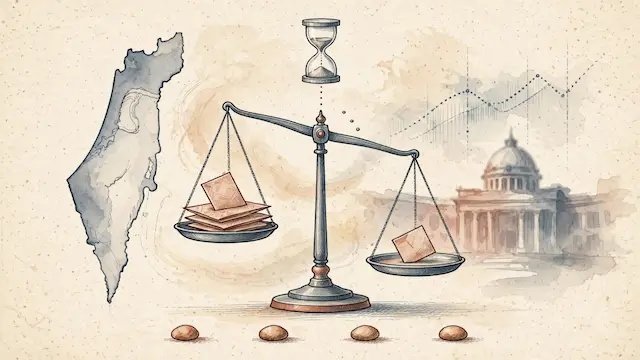
Just four days before the Israeli elections, Menachem Lazar, director of the Lazar Research Institute, cautioned that the projected seat distribution is fragile. He highlighted that the difference between parties crossing the electoral threshold and those falling short could hinge on a very small number of poll responses. Lazar stated in an interview with 103FM radio that the performance of smaller parties nearing the threshold could significantly alter the parliamentary map, recalling the 2022 elections when the Meretz party failed to pass the threshold, impacting the final outcome.
A Maariv newspaper poll released Friday indicated the coalition bloc would secure 48 seats, while the opposition bloc would get 54. The Joint List and the United Arab List together would receive 14 seats. The party led by Yoaz Hendel and Yiron Zelicha was projected to win four seats, while the party of Ofer Winter was expected to remain outside the Knesset. Lazar explained that Winter's party failing to cross the threshold favors the opposition bloc, whereas if both undecided parties pass the threshold, the blocs could become more evenly matched.
Lazar elaborated on polling methodology, noting that while typical polls survey around 500 participants, their latest poll included 1,043 respondents, supplemented by a phone survey to better represent the Arab and Haredi communities. He stressed that the margin between crossing and not crossing the electoral threshold could be as narrow as four respondents, illustrating the sensitivity for parties close to this threshold. This does not mean four voters will decide the final election outcome, but rather that a small shift in responses could change a poll's projection on a party's Knesset entry chances.
Regarding response reliability, Lazar mentioned that polling institutes use mechanisms to detect inconsistencies and verify responses against respondents' demographics. Contradictory answers on political leanings or past voting may be flagged for review, though he acknowledged these measures don't guarantee absolute truthfulness from all participants. He also pointed to voter turnout as a difficult factor to predict accurately via polls, suggesting it might be higher than the previous election's 70-71%, with increased motivation observed among supporters of the opposition and Arab parties. However, he reiterated that polls are not precise predictors of actual voter turnout.
Lazar also discussed the voting behavior of young people, including first-time voters, suggesting their patterns might differ from previous generations due to their experience with the ongoing war. While conventional wisdom suggests youth lean towards more extreme political positions, he posited that growing up during wartime might foster greater maturity in political decision-making compared to a decade ago. Ultimately, Lazar reiterated that with four days left, poll results remain susceptible to change based on the performance of parties near the threshold, actual turnout, and the accuracy of respondent answers.
Mentioned
The same event, reported separately by each outlet. Open a few to compare what different newsrooms emphasize — and what they leave out.
Right 1Arab 1

Not the same event — other stories that share this one’s people, places, or theme: background, reactions, and follow-ups.




