Israel's Water Crisis Persists as Desalination Plants Operate Below Capacity
Translated & summarized from Channel 9 by baba
Israel's desalination plants are operating at reduced capacity due to a severe microalgae bloom causing extreme seawater turbidity, with no clear end date for the crisis. To compensate, water extraction from the Kinneret has quadrupled, and other water sources are being utilized, while agricultural areas and Gaza face significant water shortages.
The story in 5 lines · by baba
- Desalination plants operate at half capacity due to algae bloom.
- Water extraction from Kinneret quadrupled amid ongoing crisis.
- Agriculture in southern Israel and Gaza face severe water shortages.
- No clear end date for the crisis is predicted.
- Algae bloom likely originated from the Nile Delta.
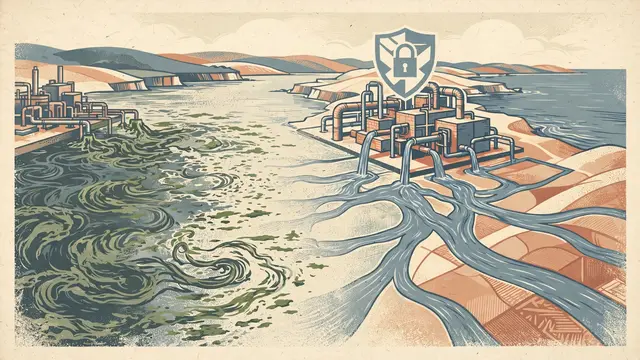
Israel's desalination crisis, triggered by unusually murky seawater, continues with no clear end in sight, despite government assurances of imminent resolution. As of mid-day, the Ashdod and Ashkelon desalination plants remain completely offline, mirroring the situation from the crisis's onset. The Hadera complex is functioning normally, being the only major Mediterranean facility that has not experienced any interruptions. Meanwhile, the Palmachim and Sorek B plants are operating at only half capacity, having also been shut down at various points during the crisis. Minister of Energy Eli Cohen stated that Sorek A has resumed operations. The decision to run plants at reduced capacity is a precautionary measure to prevent damage to filtration systems from the turbid water, which could lead to months of repairs. Instead of their usual output of approximately 18,000 cubic meters per hour, these facilities are now producing about half that amount.
The root cause of the shutdown is the abnormal turbidity of seawater, attributed to a massive bloom of microalgae originating from the Nile Delta in Egypt. This bloom has created a murky zone extending roughly 100 kilometers along the coast and seven kilometers offshore. A senior government official involved in crisis management admitted that predicting an end date is impossible, as the water's clarity depends on unpredictable wind and sea currents. Consequently, neither engineers nor officials can determine when conditions will allow the plants to return to full operation. Minister Cohen, however, maintains that the national water system is stable and there is no shortage for consumers.
To compensate for the reduced desalination output, the national water company Mekorot has increased water extraction from the Kinneret (Sea of Galilee) by fourfold, pumping over one million cubic meters daily, despite the lake's level already being below the red line. Mekorot is also utilizing approximately a thousand wells and boreholes across the country, including dormant older ones activated with Health Ministry approval for emergencies. During nighttime, when water consumption is lowest, Mekorot is directing large volumes to reservoirs to prepare for daytime demand, particularly to support agriculture in southern areas, which has been the hardest hit by the crisis.
Initial hypotheses for the plant shutdowns, including storms and cyberattacks, were quickly dismissed. The prevailing theory, supported by preliminary research from the Israel Oceanographic and Limnological Research Institute, points to the microalgae bloom. Satellite imagery confirmed large algae concentrations near the Nile Delta, with eastern Mediterranean currents capable of transporting them towards Israel. The institute's director, Alon Zask, noted that Ashkelon, Israel's southernmost desalination plant, was the first to stop, aligning with this theory. The algae are so fine they bypass the intake filters. An alternative, politically charged theory suggests that damaged sewage infrastructure in the Gaza Strip, a consequence of conflict, might have contributed to the algae bloom, implying indirect Israeli responsibility.
The crisis has led to localized water restrictions, reduced pressure, and short-term outages, with agricultural areas in the south, such as the Ramat Negev Regional Council, experiencing complete water supply cessation for farming, and farmers in Eshkol being asked to reduce irrigation. Jerusalem also faced temporary water shortages in several central neighborhoods. The situation has had direct international consequences, as Mekorot suspended water supply to the Gaza Strip, leaving approximately one million Palestinians without water, according to UNICEF.
Mentioned