
Israeli Stock Market Plummets Amid Election Uncertainty
Translated & summarized from Ynet by baba
The Israeli stock market experienced sharp declines following recent election results, creating investor uncertainty about government formation and economic stability. Experts advise against short-term reactions, suggesting a long-term perspective and noting that the market may still be overvalued. While some predict a future correction upwards once uncertainty fades, prolonged governmental paralysis could negatively impact the economy.
The story in 6 lines · by baba
- Israeli stock market plunged following election results, ending investor euphoria.
- Uncertainty over government formation and economic policy is shaking investor confidence.
- Foreign investors are reportedly exiting the market due to economic concerns.
- Experts advise investors to focus on the long term and avoid panic-driven decisions.
- The market may still be overvalued compared to historical averages and US markets.
- Prolonged governmental paralysis could lead to a negative economic outcome.
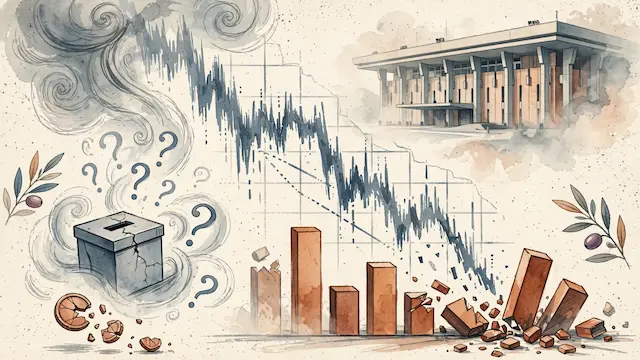
Following the recent election results, the Israeli stock market experienced a sharp decline, ending a period of investor euphoria. The uncertainty surrounding the formation of a new government, the approval of a budget, and the potential rise in the deficit has shaken investor confidence. This sentiment is affecting both local and foreign investors, with the latter reportedly exiting due to purely economic reasons.
Eldad Tamir, owner of Tamir Fishman investment house, described the situation as a "dead end," highlighting that investors dislike political instability. He noted that the inability of any bloc to form a government, coupled with the potential instability of a coalition including Arab parties, creates significant uncertainty. Tamir suggested that foreign investors, lacking emotional ties to the market, are more likely to withdraw when faced with such uncertainty. He advised investors to consider the long term, suggesting a potential increase in dollar holdings rather than making immediate changes to their portfolios, and mentioned the added threat of an attack from Iran.
Uri Ben Dov, CEO of IBI Mutual Funds, cautioned against making investment decisions based on short-term market fluctuations, comparing the stock market's short-term behavior to a casino. He recalled the legendary advice of the late Zvi Lubetzky, one of the founders of his investment house, who told panicked clients to "increase prayers." Ben Dov pointed out that the market had experienced euphoria after an event in Iran and before the elections, driven by expectations of change. He argued that even after the current declines, the Tel Aviv Stock Exchange is still trading at higher multiples (15-17) compared to its historical average (12-13) and the US market, suggesting it is not yet attractive relative to American markets.
Yeniv Pagot, Vice President of Trade at the Stock Exchange, stated it is too early to draw conclusions after just one day of trading. He believes that once the uncertainty dissipates, the market may see a correction upwards. However, he warned that prolonged governmental paralysis due to indecision could lead to a different outcome.
Mentioned
The same event, reported separately by each outlet. Open a few to compare what different newsrooms emphasize — and what they leave out.
Left 1Centre 5Right 1









Not the same event — other stories that share this one’s people, places, or theme: background, reactions, and follow-ups.



