
Israel to Establish Regulatory Framework for Massive Data Centers
Translated & summarized from Calcalist by baba
Israel's Electricity Authority will establish regulations for new data centers, allowing them to consume up to 20% of the national grid's power by 2030, with individual facilities capped at 200 megawatts. A 200-megawatt data center consumes power equivalent to a medium-sized city and costs over 4 billion shekels to build. Construction faces significant delays due to long lead times for critical equipment like chillers and gas turbines, with full power redundancy not guaranteed during outages.
The story in 6 lines · by baba
- Israel's Electricity Authority will set regulations for data centers, allowing up to 200 megawatts of power consumption per facility.
- By 2030, data centers could account for up to 20% of Israel's total electricity consumption.
- A 200-megawatt data center consumes power comparable to a medium-sized Israeli city.
- Construction of a 200-megawatt data center is estimated to cost over 4 billion shekels.
- Supply chain issues, including long lead times for equipment, are significant challenges for data center development.
- Full power redundancy for large data centers is not guaranteed during electricity outages.
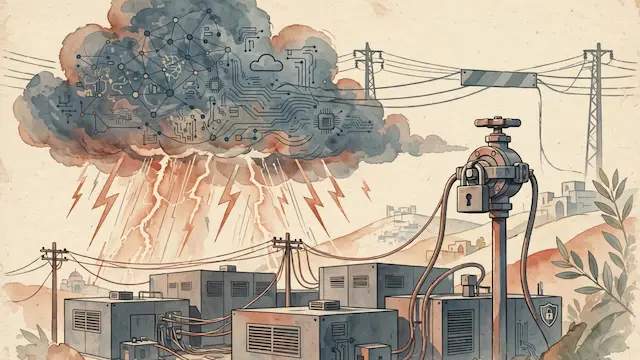
Israel's Electricity Authority is set to finalize regulatory guidelines today for connecting large-scale data centers to the national power grid. These facilities will be capped at 200 megawatts, with the potential to consume up to 20% of Israel's total electricity by 2030. A single 200-megawatt data center would consume four times the power of a large factory or a water desalination plant, comparable to the energy usage of a medium-sized Israeli city like Rehovot or Holon. For perspective, CERN, a major European energy consumer, uses approximately 200 megawatts at full capacity.
Eran Barak, CEO of data center company Serverz, explained that a large data center would occupy about 5,000 square meters, with only 1,600 square meters dedicated to server racks. The remainder would house extensive cooling systems, including chillers, and backup power solutions like generators and batteries. The construction process involves securing land near high-voltage power lines and ideally natural gas pipelines for future gas turbines. Developers must first seek preliminary approval from Noga, the system manager, followed by statutory planning and master plan submissions for a binding response.
Barak highlighted significant supply chain challenges, noting that lead times for chillers and high-voltage electrical panels can reach 18 months, while gas turbines from major manufacturers may take up to a decade to procure. Although not directly supplied by Serverz, graphics processing units (GPUs) essential for AI are also in high demand. The data center service model involves multiple layers: infrastructure providers like Serverz, chip and server component suppliers such as Neocloud companies (e.g., Nevius), and cloud service providers (e.g., Anthropic, Google, Microsoft) who utilize the infrastructure for AI models.
The construction of a 200-megawatt data center is estimated to cost over 4 billion shekels and takes approximately two years after all necessary approvals are obtained. These facilities are equipped with dual backup power systems, including large battery arrays and diesel generators, to ensure continuous operation during power interruptions. However, full redundancy for such high capacities is not feasible, meaning some servers might go offline during a blackout. Looking ahead, the industry is exploring quantum computing, which may require less space but potentially even more power.
Mentioned
The same event, reported separately by each outlet. Open a few to compare what different newsrooms emphasize — and what they leave out.
Other 2

Not the same event — other stories that share this one’s people, places, or theme: background, reactions, and follow-ups.



