
US and Israel Await Opportunity to Overthrow Iran's Regime
Translated & summarized from Vesty by baba
The U.S. and Israel are in a strategic stalemate with Iran, unable to force regime change or a diplomatic compromise. Despite military superiority and sanctions, Iran's leadership remains defiant, driven by ideology and internal power dynamics. President Trump is hesitant to launch new military operations before the U.S. midterm elections due to political concerns and potential economic repercussions. Both nations are exploring alternative strategies, with the naval blockade considered a primary pressure tool, while awaiting opportunities for a more decisive resolution.
The story in 6 lines · by baba
- US and Israel face a strategic stalemate with Iran, unable to achieve regime change or a diplomatic breakthrough.
- President Trump is delaying military action against Iran until after the U.S. midterm elections due to political and economic concerns.
- Iran's regime, led by hardliners, prioritizes power and ideological goals over economic stability and international demands.
- A naval blockade is considered the main tool of pressure on Iran, impacting its oil exports and economy.
- Both the U.S. and Israel are seeking a long-term solution beyond limited military strikes, potentially involving regime change.
- Iran has not yet resumed efforts to develop a nuclear warhead but is rebuilding its ballistic missile program.
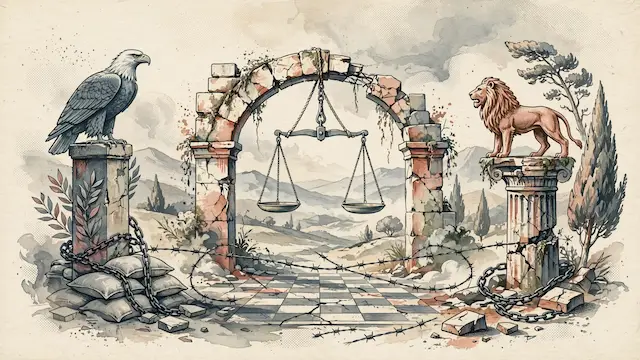
The United States and Israel find themselves in a strategic stalemate with Iran and its allies. Despite significant military superiority and a naval blockade by the U.S. Central Command (CENTCOM), Tehran has not capitulated. Military observer Ron Ben-Yishai noted on October 17 that Iran's leadership refuses even minimal demands from President Trump, such as halting nuclear weapons development and ensuring freedom of navigation in key straits. Despite heavy losses and a struggling economy, Iranian authorities are acting like victors and setting their own terms.
This defiance stems from the regime's ideological nature, prioritizing power and resistance to the U.S. and Israel, and the lack of an organized internal opposition capable of challenging the Islamic Revolutionary Guard Corps (IRGC) and the Basij militia. Trump, Secretary of State Marco Rubio, Defense Minister Pete Hegseth, Prime Minister Benjamin Netanyahu, and Israeli security chiefs have concluded that Iran's regime cannot be broken by military force alone or swayed by negotiations. Sources indicate Mojtaba Khamenei, despite injuries, maintains control and a hardline stance, supported by most IRGC and Basij leaders who reject concessions on uranium enrichment, missile and drone development, and control over the Strait of Hormuz.
A more moderate faction, including President Masoud Pezeshkian, Parliament Chairman Mohammad-Baqer Ghalibaf, and Foreign Minister Abbas Araghchi, recognizes the severity of the economic and social crisis but has limited influence. Khamenei allows them to negotiate, seeking a return to a memorandum of understanding brokered by Pakistan with U.S. Vice President J.D. Vance in Islamabad. This agreement was considered too lenient by some in Israel and among U.S. Republicans. However, after the IRGC attacked three merchant ships in the Strait of Hormuz shortly after its signing, Trump abandoned the deal, resuming military actions and the blockade.
Khamenei later sent Araghchi to pursue similar terms with slightly different wording, but Trump hardened his position, demanding Iran first agree to halt its nuclear program before discussing sanctions relief. Negotiations at the UN General Assembly failed. U.S. administration sources suggest these events convinced Trump that reaching a compromise is nearly impossible and that Iranian negotiators may lack the authority to finalize agreements. Consequently, Trump and Rubio's stance aligns more with Israel's: only a regime change in Tehran can guarantee Iran abandons its nuclear ambitions and the Strait of Hormuz remains open.
The article also discusses the challenges of overthrowing a dictatorship, noting that external military strikes are insufficient without an organized internal force. While opposition groups exist, they are not strong enough to challenge the IRGC and Basij. The author suggests that a unified opposition, potentially including the "Mojahedin-e Khalq" organization led by Maryam Rajavi, could pose a threat, but the Iranian authorities actively suppress dissent through arrests, torture, and executions. Mojtaba Khamenei has also consolidated power by appointing loyal veterans to key security positions.
Pentagon documents reveal Trump considered five limited air operation options against Iran and the Houthis, including a three-day campaign with the Israeli Air Force targeting missile sites, drones, and command centers. He discussed these with Netanyahu, and the IDF prepared for potential action. However, Trump ultimately rejected the plans, deeming them unlikely to yield significantly different results than previous operations. Concerns about potential Iranian retaliation, including attacks on oil infrastructure and Israel, as well as the depletion of U.S. missile stocks, contributed to this decision.
Israeli military and intelligence also lack a clear answer on the effectiveness of new operations. The IDF recommends patience, allowing for the production of more advanced weaponry. Currently, Iran has not attempted to extract 60% enriched uranium or restart its warhead development, though it is rebuilding ballistic missile production. Prime Minister Netanyahu stated he is not interested in an initiative strike under current conditions, though regime change remains Israel's strategic goal.
Trump's primary objective is to prevent Iran from obtaining nuclear weapons and keep the Strait of Hormuz open, but his immediate focus is the upcoming U.S. midterm elections. He fears a war with Iran would be unpopular and could increase oil prices, harming Republican candidates. Therefore, he aims to stabilize global energy markets and avoid escalating tensions before the elections.
The U.S. has implemented an operation to transport oil through the Strait of Hormuz despite Iranian threats, using smaller vessels that are harder to detect. U.S. forces conducted nighttime operations to neutralize radar sites and destroy coastal missile launchers. This system, involving transferring oil to larger tankers, had nearly restored pre-war oil export volumes until Iran developed new detection methods. This has led to reduced shipping and increased insurance costs, with a Singaporean vessel recently sunk in the Strait.
In parallel, the U.S. has deployed a third aircraft carrier strike group to the Middle East, increasing its naval presence significantly. This deployment aims to replace vulnerable land bases and enhance defensive capabilities, with some U.S. squadrons relocated to Israel. The arrival of the "Theodore Roosevelt" group is expected by late October, while the Pentagon accelerates production of missile defense systems.
The naval blockade is considered the main tool of pressure, with U.S. and Israeli intelligence believing it significantly impacts Tehran by halting oil exports and exacerbating currency shortages. However, its effectiveness might provoke escalation. Continuing the blockade, rather than launching another air campaign, is seen as an alternative. A potential loss of Republican control in Congress after the elections could limit Trump's ability to conduct prolonged military operations without legislative approval.
The main conclusion is that a new U.S.-Israeli operation might weaken Iran's military but won't cause regime collapse or permanently halt its nuclear and missile programs. Therefore, Trump is unlikely to rush into a new attack, especially if Republicans lose congressional majorities, as Washington and Jerusalem continue seeking a more comprehensive solution.
Mentioned




