
Second Suspected Ebola Case in Israel After Traveler Returns from Congo
Translated & summarized from Globes by baba
Israel’s Health Ministry said a second traveler returning from Congo is being isolated and tested for Ebola after arriving with fever and diarrhea. Officials are tracing contacts and checking whether the two suspected cases are connected, while stressing the public risk remains low for now.
The story in 5 lines · by baba
- A second Israel returnee from Congo is isolated over suspected Ebola.
- Health officials expect test results within days.
- An epidemiological investigation is tracing contacts of both suspects.
- WHO says the Congo and Uganda outbreak is an international emergency.
- The outbreak has reached 894 confirmed cases and 200 deaths.
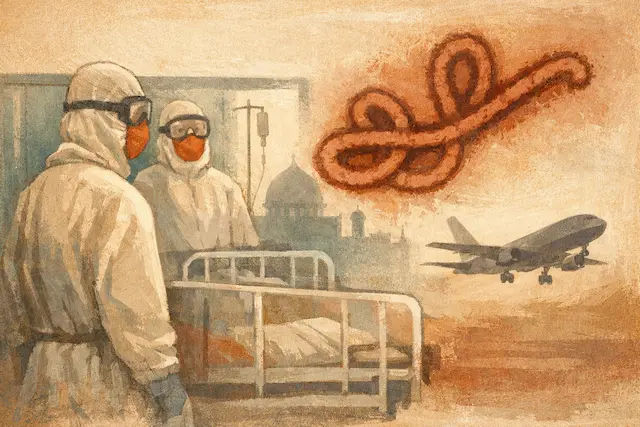
Israel’s Health Ministry said a person who recently returned from Congo arrived for medical treatment with fever and diarrhea and is now in isolation over fears of Ebola. It is the second such suspected case since the weekend. The ministry stressed that this is still only a suspicion, and test results are expected within a few days.
At the same time, officials are carrying out an epidemiological investigation to identify, and possibly isolate, the contacts of both suspected cases, and are checking whether there is any link between them. The ministry noted that even if Ebola is confirmed in Israel, the risk to the general public is currently considered low.
The article says the World Health Organization has declared Ebola in Congo and Uganda an international emergency, while hospitals there are struggling with what appears to be the largest outbreak since the disease was discovered. As of now, 894 cases have been confirmed and 200 people have died, with the numbers rising sharply. The outbreak is made harder to control by poverty, weak infrastructure, war and population movement, and many contacts are not being monitored or isolated.
Ebola is transmitted through body fluids, not through airborne droplets, and is far less contagious than Covid, measles or influenza. Patients showing flu-like symptoms are usually not yet infectious, but later, in the so-called “wet” stage, vomiting and bleeding begin and contagion increases. The text says death rates range from 10% to 40% depending on treatment quality, and that Israel’s relatively strong care system means someone who sought help soon after symptoms appeared would likely recover. There is no vaccine for the current strain, although a vaccine exists for an earlier one. The CDC has allocated $107 million, while USAID cuts in early 2025 reduced staffing and epidemiological capacity in Africa.
Mentioned
The same event, reported separately by each outlet. Open a few to compare what different newsrooms emphasize — and what they leave out.
Centre 6Right 2Haredi 1Other 1









