
Israel Health Ministry Says Ebola Readiness Is Complete After Two Suspected Cases
Translated & summarized from Now 14 by baba
Israel’s Health Ministry said two travelers from the Democratic Republic of Congo are isolated in Sheba and Rambam with suspected Ebola, pending test results. Officials say the risk of community spread in Israel is extremely low and the system is fully prepared.
The story in 5 lines · by baba
- Two returnees from Congo are isolated in Sheba and Rambam over suspected Ebola.
- The ministry says the cases are separate and final test results are still pending.
- More than 900 Ebola cases have been reported in Africa, mainly Congo and Uganda.
- Israel has prepared five hospitals and special protocols for suspected Ebola patients.
- No confirmed Ebola case has been found in Israel, and community spread is considered very unlikely.
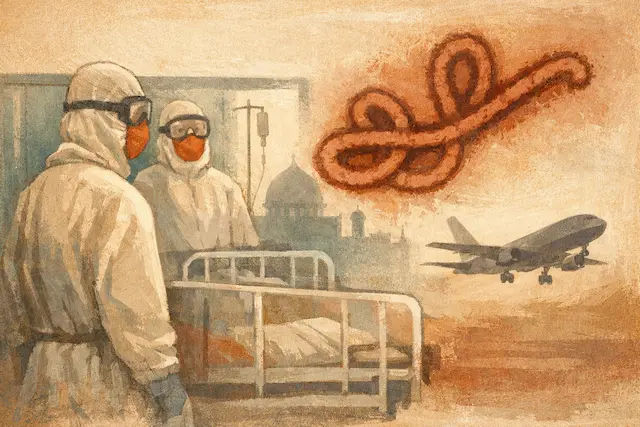
Israel’s Health Ministry said it is fully prepared after two people who returned from the Democratic Republic of Congo were hospitalized in isolation with suspected Ebola, one at Sheba Medical Center in Tel Hashomer and the other at Rambam Medical Center in Haifa. The ministry stressed that these are two separate cases and that the final test results have not yet come back.
Samples have already been taken, but officials said it can take several days to determine whether the virus is present. For now, both patients remain classified only as suspected cases. Health experts said the fact that the two arrivals reached hospitals one day apart does not indicate any connection or local transmission, and could simply be a statistical coincidence given travel from African risk areas.
The concern comes amid Ebola outbreaks in Africa, mainly in the Democratic Republic of Congo and Uganda. More than 900 cases have been reported there, with an estimated mortality rate of about 26%, though Israeli officials believe not all infections are being reported to local health authorities. Still, the ministry said no significant community outbreak of Ebola has ever been documented outside Africa, and the chance of a patient spreading the disease in Israel is considered extremely low.
The ministry explained that Ebola can kill up to 50% of patients in some cases, has an incubation period of two to 21 days, and begins with symptoms such as high fever, weakness, headache and muscle pain before potentially progressing to diarrhea, vomiting, multi-organ damage and bleeding. It is not airborne, and spreads only through direct contact with blood, body fluids or secretions from a symptomatic patient. The ministry also said fever in returning travelers is usually caused by far more common illnesses, especially malaria, but every case is checked carefully. Israel has prepared five hospitals authorized to receive suspected Ebola patients, Ichilov, Sheba, Hadassah Ein Kerem, Rambam and Soroka, along with Magen David Adom crews and evacuation protocols. No confirmed case has been found in Israel, Israelis returning from risk areas are still allowed to enter, and foreign nationals from active outbreak areas are being restricted unless an exception is approved individually.
Mentioned
The same event, reported separately by each outlet. Open a few to compare what different newsrooms emphasize — and what they leave out.
Centre 6Right 2Haredi 1Other 1









