
Health Ministry says suspected Ebola cases likely point to common illnesses
Translated & summarized from Kan News by baba
Israel’s Health Ministry said two suspected Ebola patients are more likely suffering from common travel-related illnesses such as malaria. Officials said the risk to the public is very low, while Israel keeps strict entry rules for foreigners from risk areas and prepares designated hospitals and teams for any confirmed case.
The story in 5 lines · by baba
- Israel says two suspected Ebola cases are more likely common travel illnesses.
- No quarantine is needed for passengers or the patients’ family members.
- Foreign nationals from risk areas are barred from entry without special approval.
- Five Israeli hospitals were designated for strict Ebola treatment and isolation.
- The concern follows a major Ebola outbreak in Congo and cases in Uganda.
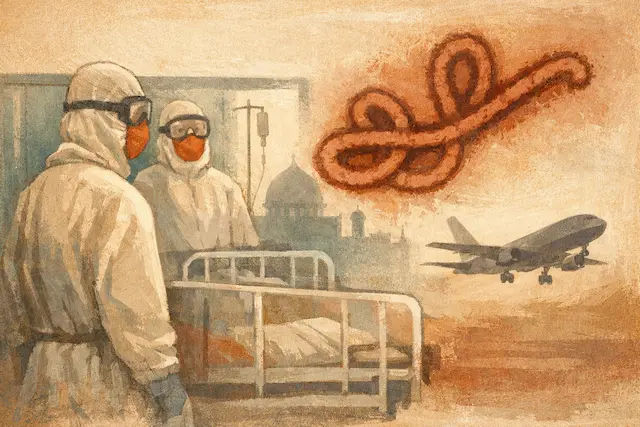
Israel’s Health Ministry said on Sunday that there is no reason to fear Ebola infection among passengers on the flights that brought back two suspected cases, and no need to quarantine their family members. Prof. Sigal Sadetzky, head of public health, also said there is no blanket isolation order for Israelis returning from Africa and no ban on travel to the continent, though foreign nationals arriving from risk areas are barred from entry unless they receive a special exemption and pass an epidemiological review.
The two patients, who are not connected to each other, developed fevers after returning to Israel and are still under evaluation. Sadetzky said it is more likely they have common illnesses seen in travelers from Africa, such as malaria. Because they arrived from risk areas, the Ebola protocol was activated. The ministry said a definitive test requires waiting 72 hours from symptom onset to ensure reliability, so results are not yet available. Both patients are hospitalized in proper isolation at Sheba Medical Center in Tel Hashomer and Rambam Health Care Campus in Haifa.
The ministry said the chance of Ebola spreading in Israel is very low. Ebola is not airborne, and an infected person becomes contagious only after symptoms begin. Transmission occurs through direct contact with bodily fluids or blood, or with objects contaminated by those fluids. Sadetzky said, “So far, export of the disease outside Africa is almost nonexistent, and when it does happen, it is contained,” adding that there has never been an Ebola case outside Africa that spiraled into uncontrolled community spread.
Health officials said Israel’s health system prepared in advance. Five hospitals were designated for strict Ebola isolation and lab capabilities: Sheba, Ichilov, Soroka, Rambam and Hadassah Ein Kerem. MDA dispatchers and transport teams also received special training for identifying and safely moving suspected patients. The cases are now being handled centrally by the hospitalization unit at the National Health Command Center. The concern comes amid a large Ebola outbreak of the Bundibugyo strain that began in May in three districts in northeastern Congo, with more than 900 reported cases and a 26 percent mortality rate, plus fears of spillover into neighboring countries. Kampala, Uganda’s capital, has also reported 19 cases, mostly imported from Congo, including health workers, with no sign of community transmission. The World Health Organization has declared an international public health emergency.
Mentioned
The same event, reported separately by each outlet. Open a few to compare what different newsrooms emphasize — and what they leave out.
Centre 6Right 2Haredi 1Other 1









