
Israeli Pollsters Face Scrutiny Over Election Forecast Failures
Translated & summarized from i24NEWS French by baba
Israeli pollsters are under fire after election forecasts failed to match the final results. Opinion poll specialist Stéphane Wahnich cited methodological issues like unrepresentative samples and underreported voting intentions as primary causes. He also noted potential unconscious political bias in model selection. Wahnich stressed that polls indicate trends, not precise predictions, warning "The figure is misleading."
The story in 5 lines · by baba
- Israeli pollsters face criticism for inaccurate election forecasts due to methodological challenges.
- Specialist Stéphane Wahnich cited unrepresentative samples and underreported voting intentions as key issues.
- The diversity of Israeli society and political landscape complicates accurate polling.
- Wahnich warned that pollsters' model selection could be unconsciously influenced by political beliefs.
- He stated polls should be seen as trend indicators, not exact predictions, calling figures "misleading."
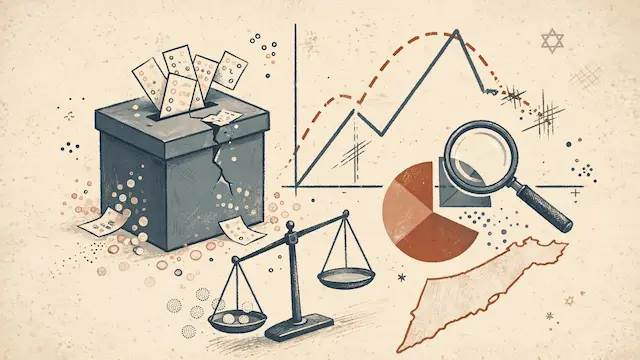
Following the Israeli legislative elections, opinion pollsters are facing criticism for significant discrepancies between their predictions and the actual results. Stéphane Wahnich, a specialist in opinion surveys and former industry professional, attributes these deviations not to political manipulation but to major methodological challenges. He highlighted the difficulty of ensuring representative samples in Israel's diverse society, where religious and community affiliations heavily influence voting. Polling only 500 to 1,000 individuals presents a considerable hurdle in accurately capturing the electorate's will. Wahnich also pointed to underreported voting intentions, suggesting some voters may be hesitant to declare support for certain parties, while intense media coverage of other candidates can temporarily sway responses. The expert noted the instability of Israel's political landscape, which complicates historical comparisons. Furthermore, Wahnich explained that pollsters must select statistical models, a choice that can be unconsciously influenced by their own political beliefs. Despite these issues, he refused to condemn polling institutes outright, acknowledging that their surveys did correctly identify certain trends, such as the erosion of the Netanyahu bloc and the rise of Gadi Eizenkot, as well as the difficulty in forming a parliamentary majority. Wahnich cautioned against the illusion of precision in polling, stating, "The figure is misleading." He concluded that polls should be viewed as indicators of trends rather than exact electoral predictions.
The same event, reported separately by each outlet. Open a few to compare what different newsrooms emphasize — and what they leave out.
Centre 2Right 1Haredi 1



Not the same event — other stories that share this one’s people, places, or theme: background, reactions, and follow-ups.




