
Voting Turnout Reveals Significant Gaps Across Israeli Cities
Translated & summarized from Behadrei Haredim by baba
Israel's national voter turnout for the 26th Knesset elections reached 66.7% by 6:00 PM, a significant increase from the previous election. Data reveals considerable differences in participation across various cities and communities. Haredi cities like Elad and Arab towns such as Kafr Qasim reported high turnouts, while major cities like Tel Aviv and Jerusalem saw lower rates. The final turnout figures are expected after polls close at 10:00 PM.
The story in 6 lines · by baba
- Overall voter turnout reached 66.7% by 6 PM, up 9% from the previous election.
- Elad and Kafr Qasim reported the highest turnouts at 71.2% and 73.9% respectively.
- Tel Aviv-Yafo recorded 58.6% turnout, significantly lower than other major cities.
- Bat Yam and Eilat showed particularly low turnouts at 47.6% and 41.8%.
- Modi'in-Maccabim-Re'ut led large cities with 70.1% turnout.
- Final turnout figures are expected after polls close at 10 PM.
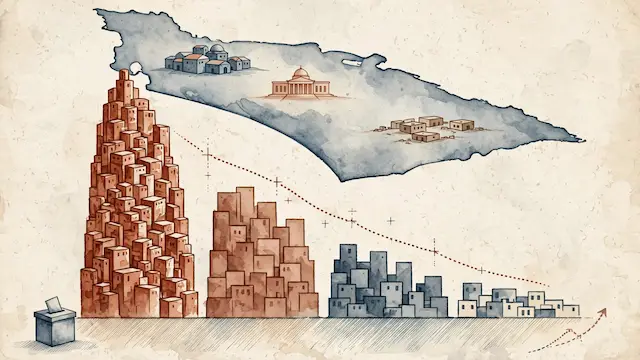
As of 6:00 PM on election day for the 26th Knesset, Israel's overall voter turnout reached 66.7%, with 4,892,186 citizens casting ballots out of 7,331,981 eligible voters. This figure represents a notable 9-percentage-point increase compared to the same time in the previous election, when turnout stood at 57.7%. Data from the Central Elections Committee highlights substantial disparities in voting participation between various types of communities, including Haredi (ultra-Orthodox) cities, Arab towns, strongholds of right-wing and opposition parties, and major urban centers.
In Haredi cities, Elad led with a 71.2% turnout, followed by Modi'in Illit at 69.8%. Other Haredi cities like Bnei Brak (64.3%), Beitar Illit (63.6%), and Beit Shemesh (57%) showed lower, though still significant, participation. The gap between Elad and Beit Shemesh exceeded 14 percentage points.
Arab communities also demonstrated high engagement in several localities. Kafr Qasim recorded a 73.9% turnout, Rahat 72.2%, and Sakhnin 71.4%. However, cities like Nazareth (58.4%), Umm al-Fahm (56.1%), and Shfaram (62.3%) had lower rates.
Cities identified with the opposition bloc generally saw high participation, with Hod HaSharon at 69.3%, Ramat HaSharon at 67.8%, and Kfar Saba at 66.3%. In contrast, Tel Aviv-Yafo recorded 58.6%, a difference of over 10 percentage points compared to Hod HaSharon.
Areas typically supporting the Likud and right-wing parties presented a mixed picture. Netivot had a 66.5% turnout, Ofakim 64.1%, and Kiryat Malachi 63.2%. Major cities like Jerusalem reported 55.3% turnout, and Haifa 54.5%. Particularly low turnout was observed in Bat Yam (47.6%) and Eilat (41.8%).
Among the largest cities, Modi'in-Maccabim-Re'ut stood out with 70.1% turnout, followed by Petah Tikva (63.1%) and Ramat Gan (61.9%). Rishon LeZion recorded 61.3%, Ashdod 59.4%, and Holon 58%. The data reflects participation rates at the time of the report, with polls remaining open until 10:00 PM, and the final figures may show shifts in these disparities.
Mentioned
The same event, reported separately by each outlet. Open a few to compare what different newsrooms emphasize — and what they leave out.
Right 2Haredi 1


Not the same event — other stories that share this one’s people, places, or theme: background, reactions, and follow-ups.




