
Election Turnout Varies Widely Across Israeli Cities and Towns
Translated & summarized from Kipa by baba
National voter turnout for the 26th Knesset elections stood at 55.7% by 4:00 PM, with significant regional differences. Haredi towns like El'ad and West Bank settlements such as Karnei Shomron reported high participation. Arab towns like Rahat also saw strong turnout, contrasting with lower rates in Nazareth and Umm al-Fahm. Major cities like Tel Aviv and Jerusalem had moderate turnout, while Kfar Saba showed a higher rate.
The story in 5 lines · by baba
- National voter turnout reached 55.7% by 4:00 PM on election day.
- Karnei Shomron in the West Bank had the highest turnout at 62.1%.
- El'ad, a Haredi town, reported a 59% voter turnout.
- Rahat, an Arab city, saw 60.6% of eligible voters cast ballots.
- Tel Aviv and Jerusalem recorded 50% and 48% turnout respectively.
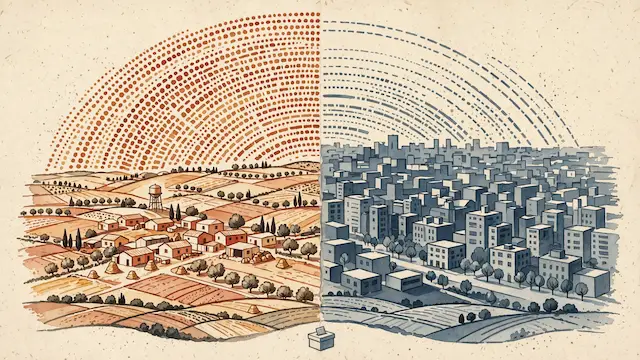
As the 26th Knesset elections continued, the national voter turnout reached 55.7% by 4:00 PM. Significant disparities in participation were observed across different cities and communities.
Higher turnout rates were recorded in several Haredi (ultra-Orthodox) towns, with El'ad leading at 59%, followed by Modi'in Illit at 58.8%, Bnei Brak at 53.3%, and Beitar Illit at 52%.
In the West Bank settlements included in the data, turnout exceeded 50%. Karnei Shomron reported the highest rate at 62.1%, with Alfei Menashe at 58%, Elkana at 57%, and Ariel at 51%.
Arab towns showed a notable range in turnout. Rahat had a 60.6% participation rate, while Nazareth saw 46.7% and Umm al-Fahm 41.7%.
Among the major cities, Tel Aviv recorded 50% turnout, Jerusalem 48%, Be'er Sheva 47%, and Haifa 46%. Rishon LeZion had 51%.
Other cities also showed varied results: Kfar Saba reported 56.6% turnout, Givatayim 55.5%, Herzliya 53.1%, and Afula 50.6%.
Mentioned
The same event, reported separately by each outlet. Open a few to compare what different newsrooms emphasize — and what they leave out.
Right 2Other 1


Not the same event — other stories that share this one’s people, places, or theme: background, reactions, and follow-ups.


