
Israel Launches Tender for Second Western Galilee Desalination Plant
Translated & summarized from Bizportal by baba
Israel has launched an international tender for a new desalination plant in the Western Galilee with a capacity of 100 million cubic meters per year. This is part of a national effort to significantly boost Israel's total desalination capacity. The project will use a BOT model and prohibits on-site power generation, unlike previous plants. Environmental considerations for brine discharge are also a key factor.
The story in 5 lines · by baba
- Israel is tendering for a second Western Galilee desalination plant with 100 million cubic meters annual capacity.
- The new plant is part of a plan to raise Israel's total desalination capacity to 1.5 billion cubic meters annually.
- The project will follow a Build-Operate-Transfer (BOT) model for nearly 25 years.
- The tender explicitly forbids an independent power station or natural gas systems at the new facility.
- Environmental concerns require a distant offshore brine discharge point, increasing infrastructure costs.
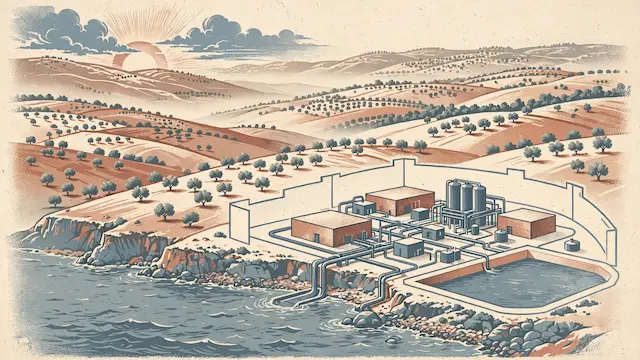
Israel is accelerating the expansion of its northern desalination capacity by issuing an international tender for a second plant in the Western Galilee. The facility, dubbed Western Galilee B, will have a production capacity of at least 100 million cubic meters annually and will be located south of Nahariya, adjacent to the existing Western Galilee A plant. Upon completion of both facilities, the site's total desalination capacity is expected to reach approximately 200 million cubic meters per year.
This initiative is part of a broader national plan to increase Israel's total desalination capacity from the current 800 million cubic meters per year to 1.5 billion cubic meters by the early to mid-2030s. The plan also includes expanding the Ashkelon plant and constructing a new one in Emek Hefer. The government is preparing for a long-term goal of 2 billion cubic meters of desalinated water annually.
The project will operate under a Build-Operate-Transfer (BOT) model, where the concessionaire will finance, design, build, operate, and maintain the plant for nearly 25 years before transferring it to the state for free. The government will purchase the desalinated water. The tender process involves two stages: preliminary qualification of international and domestic consortia, followed by a price tender among the shortlisted bidders.
A notable stipulation in the tender documents prohibits the construction of an independent power station or natural gas-based systems at the site. Electricity must be supplied solely from the national grid, a departure from the Ashkelon plant, which has its own private gas-powered facility. This decision reflects lessons learned from past incidents where large desalination plants were temporarily shut down during peak electricity demand, impacting water supply.
The tender also addresses environmental concerns, particularly the sensitive marine ecosystem in the area. The brine discharge pipeline is expected to be located much farther offshore than is typical for similar projects in Israel. The selection of the discharge point will be made in coordination with the Ministry of Environmental Protection and the Nature and Parks Authority, a process that will increase marine infrastructure costs.
Mentioned
The same event, reported separately by each outlet. Open a few to compare what different newsrooms emphasize — and what they leave out.
Other 3


Not the same event — other stories that share this one’s people, places, or theme: background, reactions, and follow-ups.
