
Court Orders National Insurance to Recognize Firefighter's Lung Disease as Work Injury
Translated & summarized from Ice by baba
A veteran firefighter's lung disease has been recognized as a work-related injury by the Regional Labor Court in Tel Aviv. The court ordered the National Insurance Institute to pay the 70-year-old firefighter 7,000 shekels for legal costs after ruling in his favor. The decision was based on two out of three medical expert opinions that established a causal link between his occupational exposure to smoke and his condition, overriding the National Insurance Institute's initial denial.
The story in 5 lines · by baba
- A veteran firefighter's lung disease was recognized as a work injury by the Regional Labor Court in Tel Aviv.
- The court ordered the National Insurance Institute to pay the firefighter 7,000 shekels for legal expenses.
- Two of three medical experts found a causal link between the firefighter's smoke exposure and his lung disease.
- The firefighter worked for decades, often without adequate respiratory protection during fire suppression.
- The ruling was issued at the end of August 2026, with an appeal period of 30 days.
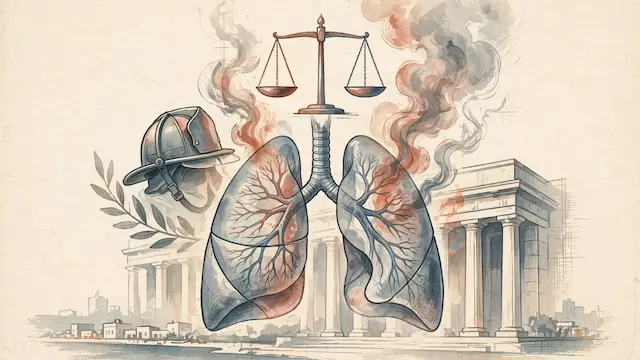
The Regional Labor Court in Tel Aviv has ruled that a veteran firefighter's lung disease should be recognized as a work-related injury, ordering the National Insurance Institute to pay him benefits. The firefighter, who is 70 years old, worked in two periods, from 1978 to 1985 and again from 1998 until his illness was discovered. During his service, he participated in extinguishing various fires, including those in forests, fields, homes, cars, and factories, exposing him to smoke and combustion byproducts from materials like rubber, plastic, and fuel. The use of respiratory protective equipment was inconsistent, and almost nonexistent in open-field fires.
In 2018, CT scans revealed fibrotic and emphysematous changes in his lungs, leading to symptoms such as a dry cough, chest pain, and shortness of breath. His claim to the National Insurance Institute was denied in May 2021, prompting him to appeal to the labor court. The court appointed three medical experts to assess the link between his occupational exposure and his lung condition.
While the first expert found no evidence of lung disease or respiratory impairment, two subsequent experts concluded there was a causal link between prolonged smoke exposure at work and his lung damage. The second expert diagnosed a restrictive lung disease, noting that the absence of smoking history supported a causal connection. The third expert also identified lung damage, including fibrotic and emphysematous changes and asthma, stating a greater than 50% probability of a link to occupational exposure.
The National Insurance Institute contested the findings, arguing that the experts' assessments lacked precise data on smoke exposure and that other conditions, like a diaphragmatic hernia and reflux, might explain the symptoms. However, the court, presided over by Judge Dafna Chason Zecharia, rejected these arguments. The judge found the first expert's opinion inconsistent with medical findings, including CT scans and respiratory challenge tests indicating airway hyperresponsiveness.
Conversely, the court deemed the latter two medical opinions clear and consistent, acknowledging that while hernia and reflux could contribute, they did not fully explain the extent of the lung damage. The court also applied a legal principle favoring the insured when medical opinions are of similar weight but conflict, stating that two experts supported the firefighter's claim against one who denied it. Consequently, the court accepted the claim, recognizing the lung disease as a work injury, and ordered the National Insurance Institute to pay the firefighter 7,000 shekels for legal expenses and attorney fees. The ruling was issued at the end of August 2026, with parties having 30 days to appeal to the National Labor Court.
Mentioned
The same event, reported separately by each outlet. Open a few to compare what different newsrooms emphasize — and what they leave out.
Other 2
