
Betting Markets Surpass Polls in Predicting Israeli Election Outcomes
Translated & summarized from Bizportal by baba
Betting and prediction markets are increasingly used to forecast Israeli election outcomes, surpassing traditional polls. Platforms like Polymarket show Gadi Eisenkot leading Benjamin Netanyahu for the prime minister role, with significant sums traded. Critics warn about market liquidity issues and the potential for manipulation in less active markets, contrasting this with polls measuring voting intentions.
The story in 5 lines · by baba
- Betting markets are increasingly used to predict Israeli election outcomes over traditional polls.
- Gadi Eisenkot leads Benjamin Netanyahu in prediction markets for Israel's next prime minister.
- Tens of millions of dollars have been traded on Israeli election outcomes in prediction markets.
- Critics warn that less liquid prediction markets can be manipulated by concentrated betting.
- Polymarket shows Eisenkot's party leading Likud in the largest party market.
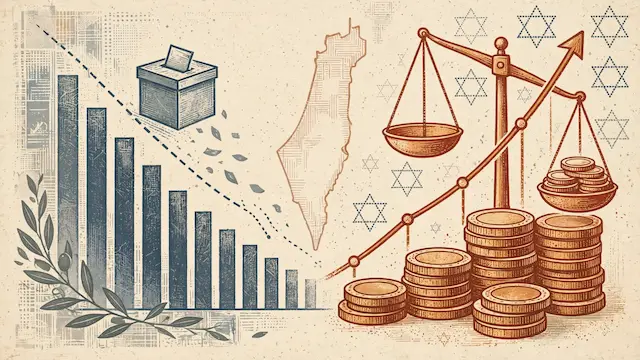
As the next Israeli elections approach, betting and prediction markets are increasingly being used to forecast outcomes, surpassing traditional opinion polls, according to Bloomberg. Platforms like Kalshi and Polymarket are seeing significant activity, with some media outlets partnering with them to display real-time odds. This surge in popularity follows a 2024 legal victory for Kalshi, which allowed trading on U.S. election results, opening the door for similar markets globally. Critics, however, express concerns about new risks to democracy.
The Israeli elections have become a highly active market, with tens of millions of dollars traded. These prediction markets function like stock exchanges, where contracts on future events are traded. A contract's price reflects the probability assigned by participants; for instance, a contract trading at 49 cents implies a 49% chance of the event occurring. Unlike polls that ask about voting intentions, these markets reflect what participants, who have money at stake, believe will actually happen, with prices updating continuously based on new information.
On Polymarket, in the market for "Prime Minister of Israel after the next election," Gadi Eisenkot leads with an approximate 48.8% probability, followed by Benjamin Netanyahu at around 29%, Naftali Bennett at 16%, and Avigdor Lieberman at 2.4%. The market will close based on who is officially appointed and sworn in as prime minister after the elections, excluding interim or caretaker governments. In the market for the largest party, Eisenkot's party is projected to receive about 69.5%, while the Likud party is at 30.5%. The most likely scenario for the Likud is 20 to 24 seats, with a 42% probability. Participants assign a 92% chance that the elections will be held on schedule.
The situation becomes more complex when considering coalition formation. In a market assessing whether either the Netanyahu bloc or the opposition bloc will reach 61 Knesset seats, the chance stands at only about 14.5%. Another market gives the opposition bloc 57.5% of gaining more seats, compared to 42.5% for the Netanyahu bloc. On Kalshi, in a market for Netanyahu's successor, Eisenkot leads with a price of about 57 cents, and Bennett is second with 18 cents.
A key warning concerns market liquidity. While major markets, like those for U.S. presidential elections, are highly liquid and difficult to manipulate, many markets on Kalshi and Polymarket, including those for Israeli elections, are less liquid. In these less liquid markets, concentrated betting can temporarily sway probabilities, creating a false impression of a candidate's changing chances. Critics also point out that polls measure voting intentions, whereas prediction markets aim to forecast the actual outcome.
Mentioned




