
Israel's Supreme Court Bans Reporting Voter Numbers from Polling Stations
Translated & summarized from Makor Rishon by baba
Israel's Supreme Court has ruled that election observers and party representatives are forbidden from reporting real-time voter turnout numbers from polling stations to their parties. The majority decision, citing lack of legal basis and privacy concerns, expands a prior ban on reporting voter identities. The ruling faced strong criticism from coalition parties, who accused the court of interfering with the electoral process and attempting to undermine the government.
The story in 5 lines · by baba
- Israel's Supreme Court banned reporting real-time voter numbers from polling stations to parties.
- The ruling expands a previous ban on reporting voter identities from polling stations.
- Justices cited lack of legal authorization and voter privacy concerns for the decision.
- The decision was made by a majority of Justices H. Kabub and R. Ronen.
- Coalition parties strongly criticized the ruling, calling it election interference.
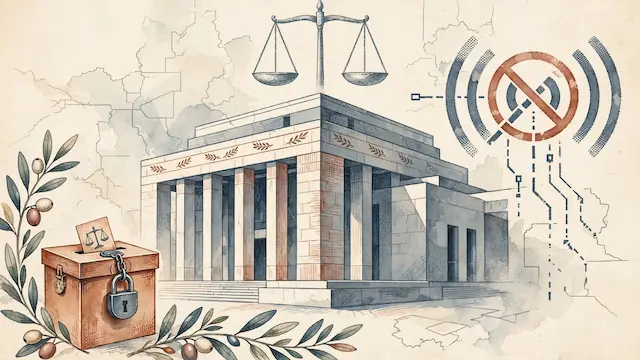
Israel's Supreme Court ruled on Thursday that election observers and committee members are prohibited from reporting real-time voter turnout numbers to their parties, expanding a previous ban on reporting voter identities. The decision, made by a majority of Justices H. Kabub and R. Ronen against the dissenting opinion of Justice D. Mintz, makes a conditional order absolute. This means representatives at polling stations cannot digitally count and transmit the number of voters who have cast ballots in a specific station to their party in real-time.
The court's reasoning, to be detailed later, cited a lack of explicit legal authorization for such reporting, adhering to the principle of legality in administration, and a violation of voters' privacy. This ruling adopts the position of Committee Chairman Justice Solberg, rejecting the committee's plenary view.
Justice Yael Vilner, with Justices Alex Stein and Khaled Kabub concurring, wrote that without explicit legal authorization, party representatives are not permitted to transfer this information. She emphasized that the long-standing practice of such reporting does not legitimize the problematic procedure, as no legal basis has been presented to empower party representatives to share voter turnout data. "The existence of a long-standing practice, even if it amounts to a 'custom,' cannot replace the required authorization for carrying out the practice in question," Vilner stated.
The previous ruling, which prohibited reporting voter identities, had drawn sharp criticism from coalition parties. Justice Minister Yariv Levin accused the court of attempting to obstruct the government's reform agenda and manipulate election outcomes by changing the rules mid-game. The Religious Zionism party also criticized the decision, claiming it was designed to hinder right-wing parties' ability to mobilize voters and represented a blatant intervention in the electoral process, underscoring their call for a strong judicial reform.
Mentioned
The same event, reported separately by each outlet. Open a few to compare what different newsrooms emphasize — and what they leave out.
Centre 2Right 1Haredi 2Arab 2Other 1







Not the same event — other stories that share this one’s people, places, or theme: background, reactions, and follow-ups.


