
Greece Prepares for Subsea Power Cable Project Amid Turkish Tensions
Translated & summarized from Globes by baba
Greece is moving forward with the Interconnector project, a subsea power cable connecting Greece, Cyprus, and Israel, despite Turkish objections. Turkey disputes the maritime area south of Crete where the cable will be laid, leading to conflicting NAVTEX declarations. While Turkey has previously threatened to disrupt cable laying, Greece, bolstered by recent defense deals with Israel, appears more determined this time. The project is strategically important for Israel's energy security and has support from the EU and the US.
The story in 6 lines · by baba
- Greece is preparing to lay a subsea power cable connecting it to Cyprus and Israel, sparking Turkish objections.
- Turkey disputes the maritime area south of Crete where the cable is planned, leading to conflicting NAVTEX declarations.
- A previous attempt to lay the cable was postponed due to Turkish threats, but Greece is now more resolute.
- The Interconnector project is strategically vital for Israel's energy grid redundancy and security.
- The project has secured support from the European Union and the United States.
- French companies have a significant financial interest in the Interconnector project.
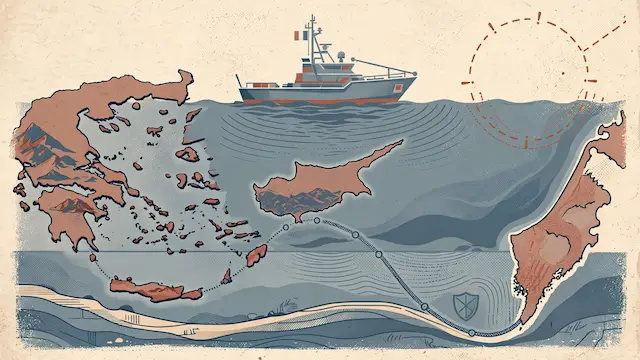
Greece is preparing to resume work on the Interconnector project, a high-voltage subsea power cable intended to link the electricity grids of Greece, Cyprus, and Israel. The French vessel "Abeille Maringo" is expected to conduct maritime surveys soon as part of these preparations. This move, however, risks escalating tensions with Turkey, which disputes maritime boundaries with Greece and Cyprus.
The potential conflict zone is south of Crete, where Turkey views the area as under its jurisdiction. This dispute has already led to a naval standoff. Last Thursday, Greece announced a closed maritime area south of Crete for the "Onomia 2026" military exercise, involving Cyprus, France, and Italy. Turkey responded with a counter-NAVTEX declaration for the same region, asserting its claims. "NAVTEX is a warning to sailors to stay away because the military may conduct exercises that could damage ships," explained Dr. Haim Itan Cohen Yanarojak, an expert on Turkey.
This is not the first time Turkey has challenged the project. About 18 months ago, Greece postponed cable laying operations between Rhodes and Crete after Turkey threatened to cut the cables, opting to avoid a military confrontation. However, Greece's recent multi-billion dollar defense procurement from Israel has seemingly bolstered its resolve.
Dr. Galia Lindenshtrauss, a senior researcher at the Institute for National Security Studies, noted that Ankara strongly opposes the Interconnector project because it is slated to pass through an area defined by the 2019 Turkish-Libyan maritime agreement. This agreement, a cornerstone of Erdogan's "Blue Homeland" doctrine, creates a maritime border at the expense of Greek territory and reflects Turkey's neo-Ottoman maritime ambitions in the Eastern Mediterranean.
Turkey's Vice President, Cevdet Yılmaz, announced a significant increase in the defense budget, with a 229% rise in arms procurement planned by 2027. Ankara is aware of the project's strategic importance for Israel, providing critical backup and redundancy for its power grid. Experts believe Greece will likely involve additional players like the US and France to pressure Turkey, especially given French companies' significant financial stake in the project. Despite the tensions, Greece, Cyprus, and Israel view the Interconnector as a vital asset, unlike the canceled EastMed gas pipeline, and have secured support from the European Union and US Secretary of State Marco Rubio.
Mentioned
The same event, reported separately by each outlet. Open a few to compare what different newsrooms emphasize — and what they leave out.
Centre 1Other 1


Not the same event — other stories that share this one’s people, places, or theme: background, reactions, and follow-ups.
